

Police departments cannot afford to ignore their own RIPA data

Sacramento’s 2024 stop data demonstrate why agencies must examine disparities, validate their conclusions and identify problems before someone else does it for them
California law enforcement agencies devote substantial time to collecting stop data required by the Racial and Identity Profiling Act. Officers enter information about the perceived characteristics of the person stopped, the reason for the stop, actions taken, searches, evidence discovered, property seized and the final disposition.
But collecting the data is only the first obligation.
Police departments also need to understand what their data reveal—and what they do not. An agency that waits until an advocacy organization, journalist, attorney or oversight body publishes an analysis is already operating from behind. Its leaders may be forced to respond publicly before they know whether the published statistics are accurate, whether the correct population was analyzed or whether their own data contain legitimate warning signs.
That is the broader lesson from my recent report, Beyond Disparity: A Practical Review of Sacramento PD RIPA Stop Data. The report evaluates the Sacramento Police Department’s 2024 RIPA records in response to the ACLU of Northern California’s May 2026 report, Driving While Black and Brown.
The purpose of my review was not to make Sacramento’s disparities disappear. They do not. Nor was it to presume that every disparity established discriminatory enforcement. It does not.
The purpose was to test the claims against the data, use more precise analytical populations and identify where statistical findings should lead to a case-level audit.
Disparity is a starting point, not a verdict
The ACLU reported that Black people constituted approximately 12% of Sacramento’s population but 33% of its traffic stops. It also reported higher search rates for Black and Latino drivers and concluded that the disparities painted a clear picture of racially biased, pretextual enforcement.
Those findings raise legitimate questions. The dispute is not whether a disparity exists. The more difficult question is what the disparity proves.
Residential population is a useful screening benchmark, but it is an imperfect measure of traffic-enforcement exposure. It does not account for who is driving, where and when people travel, nonresident motorists, vehicle condition, actual violation rates, calls for service or the geographic deployment of officers.
A population comparison can identify a difference requiring investigation. By itself, however, it does not tell us why the difference occurred.
That distinction is important. Police leaders damage their credibility when they dismiss a disparity merely because the data do not prove discrimination. Advocacy groups and commentators make the opposite error when they treat an aggregate disparity as conclusive proof of officer motivation or an equal-protection violation.
Sound analysis requires more discipline from both sides.
Know what is being counted
My Sacramento review began with a basic question: What does each row of RIPA data represent?
The 2024 dataset contained 24,104 person records in which a traffic violation was coded as the reason for the stop. That figure replicated the ACLU’s reported 2024 traffic-stop count. But those records represented 23,126 distinct stop identifiers—not 24,104 unique driver stops.
RIPA is primarily person-level data. A vehicle stop involving a driver and a passenger may produce more than one reportable person record. Treating every row as a separate driver stop can make the language of an analysis more precise than the underlying data.
I therefore developed a narrower population consisting of traffic-violation, vehicular, officer-initiated, non-passenger, first-person records. That population contained 21,208 apparent-driver stops.
The refined denominator improved analytical accuracy, but it did not explain away the disparity. Black individuals constituted 31.2% of the apparent-driver population, compared with 31.9% in the broader traffic-violation population.
That is an important finding in both directions. The original denominator was broader than unique driver stops but correcting it did not materially change the racial distribution. A responsible review must disclose both facts.
Search disparities need more than one statistic
Searches present an even greater analytical challenge.
Among Sacramento’s apparent-driver stops, the full-search rates were:
10.8% for Black drivers;
7.4% for Hispanic or Latino drivers;
4.6% for White drivers; and
3.9% for Asian drivers.
I also conducted an adjusted analysis controlling for measured age, grouped gender, traffic-violation type, nighttime and weekend stops. Black apparent drivers had approximately twice the odds of receiving a full search as White drivers. Hispanic or Latino drivers had approximately 24% higher odds.
The Black-White difference was statistically significant and operationally meaningful. It is a legitimate audit signal that should not be minimized.
It is not, however, a complete explanation of why the searches occurred.
Parole, probation or another supervision-related authority was recorded in 59% of full searches of Black apparent drivers, 54% of White-driver searches and 46% of Hispanic or Latino-driver searches. Removing searches carrying that basis substantially reduced the absolute search rates, although the relative Black-White disparity remained.
Supervision status therefore provides important context, but not a complete answer.
The next step should be a review of individual cases. When did the officer learn of the person’s supervision status? Was the search condition confirmed? Did the officer know about it before initiating the stop or only afterward? Was the initial enforcement action independently supported? What do the report, citation, dispatch history and body-worn video show?
RIPA data can direct an agency toward those questions. In most cases, they cannot answer them alone.
Search likelihood and search productivity are different questions
The ACLU reported that 90% of searches resulted in no property or contraband being seized. That figure presents another lesson for police analysts: Definitions and denominators matter.
Discovery and seizure are different RIPA outcomes. An officer may discover contraband or evidence without the event being coded as a seizure in the way a particular analysis defines that term. Productivity rates must also be calculated among searched persons, not among all stopped persons.
In Sacramento’s apparent-driver population, 30.2% of full searches recorded a discovery, while 15.8% recorded a seizure. After adjustment for measured factors, race and ethnicity were not statistically significant predictors of discovery.
This does not establish that officers applied equal thresholds when deciding whom to search. A department cannot use a discovery rate to erase a disparity in search decisions.
It does show that search likelihood, discovery and seizure are separate questions. Each tells command staff something different:
How frequently was each group searched?
What legal authority supported the search?
How often did the search produce contraband or evidence?
What was seized?
Did productivity vary by officer, unit, violation, location or search basis?
Collapsing these questions into a single statistic may generate an effective headline, but it does not produce a complete operational assessment.
Not every result favors the agency
An internal RIPA review should not begin with a predetermined goal of rebutting criticism. If the purpose is merely to defend the department, analysts will lose credibility and may overlook real problems.
My Sacramento analysis identified several areas warranting targeted review. Window-obstruction enforcement stood out.
The apparent-driver dataset contained 1,090 window-obstruction stops. Black and Hispanic or Latino drivers constituted approximately 35% and 40%, respectively, of those stops. Black drivers had a 16.5% full-search rate, compared with 8% for White drivers.
Those numbers do not establish that window-obstruction laws were used as a racial pretext. They do justify examining the cases more closely, particularly stops followed by a search, prolonged detention, force or no citation, warning or arrest.
A useful audit would compare similarly situated stops within the same Vehicle Code section, locations, time bands, officers and enforcement units. It should evaluate whether the violation was documented consistently, why a search followed and whether enforcement outcomes complied with policy and supervisory expectations.
A department willing to perform that examination is not conceding unlawful conduct. It is demonstrating that its conclusions are based on evidence rather than institutional instinct.
Build a recurring RIPA review process
RIPA analysis should be an ongoing management function, not an emergency response to public criticism.
At a minimum, agencies should establish a quarterly or semiannual review that follows the enforcement decision pipeline:
Stop population → reason for stop → violation → actions taken → search authority → discovery or seizure → citation, warning, arrest or no action
The review should distinguish among person records, distinct stops, drivers, passengers, calls for service and officer-initiated activity. Analysts should examine raw disparities and, when the data permit, comparisons accounting for age, gender, violation type, time, location, officer, unit and legal search authority.
Automated quality checks should identify:
Multiple person records associated with one stop;
Missing search bases;
Searches recorded without a corresponding action;
Impossible or inconsistent field combinations;
Unusual stop durations;
Abrupt changes in reporting practices;
Officers or units with patterns materially different from comparable assignments; and
Enforcement categories combining high discretion, substantial disparity and low yield.
Agencies should also be cautious about comparing themselves with another department. In my report, Sacramento and Oakland had the same 30.2% discovery rate among apparent-driver full searches and the same 4.4% arrest rate. Yet their traffic-enforcement mixes and outcome coding differed substantially.
Peer comparisons may help identify unusual patterns, but differences in policy, deployment, enforcement priorities and coding can make another agency a poor control group.
Use RIPA data to guide body-worn camera audits
One of the greatest benefits of routine RIPA analysis is that it helps departments identify—and narrowly frame—questions the data cannot answer by themselves.
RIPA data can show that one group was searched more frequently, received a particular enforcement action more often or experienced a lower rate of citations or contraband discoveries. It generally cannot establish the complete legal and factual circumstances of an individual stop. It does not show everything the officer observed, the sequence in which information became known, how the officer communicated with the driver or whether similarly situated motorists were treated consistently.
Because most agencies now use body-worn cameras, departments have a practical means of moving from statistical patterns to case-level review. The data can be used to select a random or stratified sample of stops from a narrowly defined category and then compare the RIPA record with the body-worn camera recording, incident report, citation and dispatch history.
For example, an agency could randomly sample traffic stops of Black drivers for window obstruction and examine:
Whether the recorded obstruction was visible and supported the stop;
How the officer described the reason for the stop;
Whether additional enforcement or investigative activity followed;
What facts supported any detention, frisk or search;
Whether consent was requested and voluntarily given;
Whether the RIPA record accurately reflected the encounter; and
Whether comparable stops were handled consistently across officers, units and demographic groups.
A properly designed audit should not presume misconduct. It should test whether the statistical signal corresponds with lawful, consistently applied enforcement—or whether it reveals a pattern requiring additional review.
When a department identifies discrepancies through its own audit, openly acknowledges them and takes corrective action, its transparency carries greater credibility than a response issued only after outside criticism. Repeated findings may expose unclear policy, inconsistent supervision, deficient data entry or a need for focused training. The review may also confirm that officers acted lawfully and professionally under circumstances that the RIPA fields could not capture.
Regular auditing creates accountability in both directions. Officers who know that selected encounters may be compared with their RIPA submissions and body-worn camera recordings have an additional reason to remain within policy and document their actions accurately. Officers who make mistakes can be corrected before a pattern develops. Those whose recordings demonstrate sound judgment, professionalism and accurate reporting can be recognized for good work.
RIPA analysis is therefore most useful when it does more than produce annual percentages. It should help a department decide which encounters to examine, which questions to ask and where supervision or training can improve performance.
Data literacy is part of organizational readiness
Police executives do not need to become statisticians, but they should be able to ask informed questions about their own data.
What is the denominator? Are we counting people, stops or drivers? Is the comparison descriptive or adjusted? What information is missing? Does the result identify a disparity, a low-yield practice or possible differential treatment? What additional records must be examined before reaching a conclusion?
Agencies should be prepared to defend sound practices when public claims go beyond the evidence. They must be equally prepared to correct practices when their own analysis identifies an unjustified disparity, an inconsistent policy application or a data-quality failure.
Those responsibilities are not in conflict.
The proper command response to RIPA data is neither automatic denial nor automatic condemnation. It is disciplined analysis, transparent acknowledgment of limitations and targeted review of the places where discretion and disparity intersect.
If police departments do not develop that capacity themselves, someone else will interpret the data for them—and the agency may not understand the evidence well enough to know which criticisms to challenge and which ones demand action.
References
American Civil Liberties Union of Northern California. Driving While Black and Brown: The Case for Banning Racially Biased Traffic Stops in Sacramento. May 2026. https://www.aclunorcal.org/app/uploads/2026/05/FINAL-Sacramento-Pretext-Stop-Report_05.26.pdf
Vernon, Paul B. Beyond Disparity: A Practical Review of Sacramento PD RIPA Stop Data—Descriptive Findings, Comparative Context, Limits of Inference, and Audit Recommendations. West Coast Police Integrity Advisors LLC, July 2026.
Author biography
Paul B. Vernon is a law-enforcement analyst and the principal of West Coast Police Integrity Advisors LLC. His work includes RIPA data analysis, police-practices review, statistical analysis and consultation concerning law-enforcement policy and accountability. He previously served in law enforcement and provides independent analytical and expert-witness services to public agencies and attorneys.
An Indictment Is Not a Use-of-Force Analysis - People v. Matthew Neely
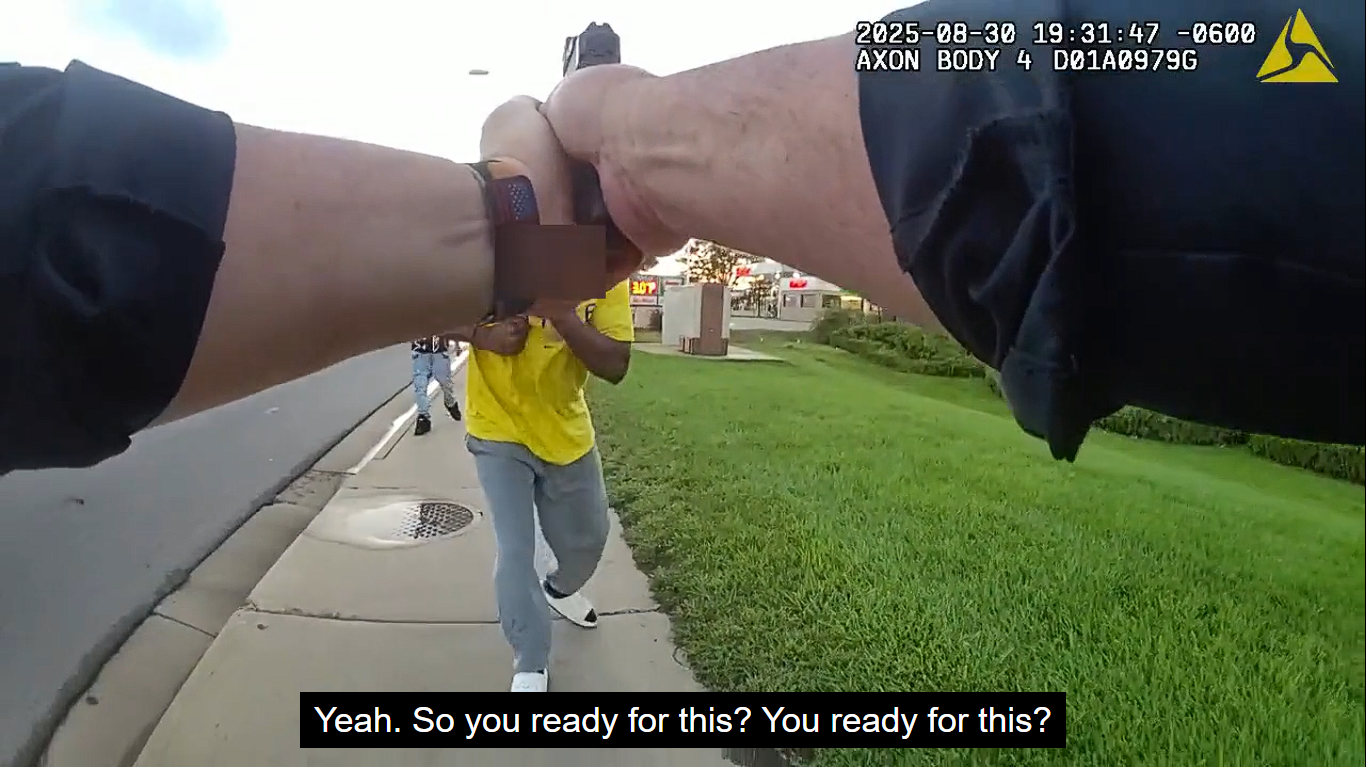
Now indicted Aurora PD officer Matthew Neely attempting to hold combative suspect at bay until back up arrives.
A grand jury’s indictment of Aurora Police Officer Matthew Neely for second-degree murder and manslaughter is serious. It is not a verdict. Several facts in the indictment may cut against the conclusion prosecutors want the public to draw.
The confrontation began after Rajon Belt-Stubblefield allegedly accelerated away from Neely and crashed into two vehicles. He disobeyed commands to remain in the Jeep, emerged with a handgun and threw it into nearby grass. He then repeatedly directed companions to “go get that shit.” Neely was alone, had already been knocked to the ground during a struggle and faced a larger, younger man while others moved near a recoverable firearm. Those facts also appeared in Police Chief Todd Chamberlain’s early account—an account that drew accusations that he had prejudged the shooting.
These details define the environment in which reasonableness must be judged.
The indictment emphasizes what Neely did not do: continually update dispatch, announce an arrest, successfully holster his pistol, deploy pepper spray, or repeat his earlier warning -- “I’ll shoot you” --immediately before firing. Some are legitimate tactical questions. But tactical imperfection is not automatically criminal recklessness, much less murder.
Colorado law asks whether an officer reasonably believed lesser force was inadequate and he faced imminent death or serious bodily injury. It generally requires a warning unless one would increase the danger. A jury should consider Neely’s earlier warning and whether another was feasible, not demand magic words in the final second.
The indictment says Belt-Stubblefield raised both fists, adopted a boxer’s stance, challenged Neely with words to the effect of “Are you ready for this?” and advanced while Neely backed into traffic. It admits Belt-Stubblefield chose to exit the car with gun in hand rather than leave, then throw the gun and invoke compatriots to retrieve it. His empty hands are relevant, but not conclusive, when an armed officer says he feared being overpowered and disarmed. That does not automatically justify shooting. It does make the state’s repeated emphasis that Belt-Stubblefield’s hands “appeared to be empty” an incomplete description of the threat Neely says he perceived.
The third shot—to the head after two rounds to the chest—will draw the closest scrutiny. Neely reportedly said the first two rounds did not stop the threat, so he changed his target. Police train in a “failure drill” for a threat that continues after center-mass hits. That is context, not a legal safe harbor; every shot must be justified. Yet body-camera video shows a sequence lasting well under a second. Belt-Stubblefield appears upright through the recoil and begins collapsing immediately afterward. The video does not show a distinctly later execution-style shot at a man already down or visibly neutralized.
More troubling is the indictment’s repeated reliance on what “Defendant stated.” If those quotations came from a compelled administrative interview, their use would raise a serious Garrity issue. Under Garrity v. New Jersey, a compelled statement—and evidence derived from it—may not be used against an officer in a criminal case.
The public document does not reveal enough to declare the grand jury tainted. But it quotes Neely’s explanations about preserving surprise, changing targets, and fearing disarmament. The district attorney should identify the source of those statements and, if they were compelled, explain how the grand-jury presentation was insulated from them. A “clean-team” investigator cannot cure the problem merely by repeating protected answers through another witness.
That uncertainty feeds a larger concern. Why does the indictment catalogue tactical criticisms while giving comparatively little weight to facts that may establish reasonable fear? Why quote Neely’s explanations if the public cannot determine whether the statements were lawfully available to prosecutors? Those choices do not prove an ideological prosecution, but they justify skepticism about whether the district attorney is neutrally testing criminal culpability or trying to make an example of this officer.
That distinction matters because the process can become the punishment. Even an acquitted officer may face crushing legal expenses, years of uncertainty, public condemnation, and the practical end of a law-enforcement career. A union or insurer may cover some costs, and reinstatement may be legally possible. None of that restores lost years or reputation or the longevity lost to stress. A prosecutor need not win a case to impose life-altering consequences.
Neely is entitled neither to automatic exoneration because he wore a badge nor to a presumption of guilt because a grand jury found probable cause. Prosecutors should charge an officer when the evidence supports a good-faith belief that a crime can be proved beyond a reasonable doubt. But if this case is being used to announce a political position, punish an unpopular use of force or satisfy an ideological constituency, then the criminal process is being misused. The public deserves assurance that the charge rests on evidence of an unjustified shooting—not hindsight, a tactical checklist, or a desire to place an officer on trial simply because placing him on trial is itself the desired result.
LAPD Shootings Are Up. The Usual Explanation Is Not Good Enough
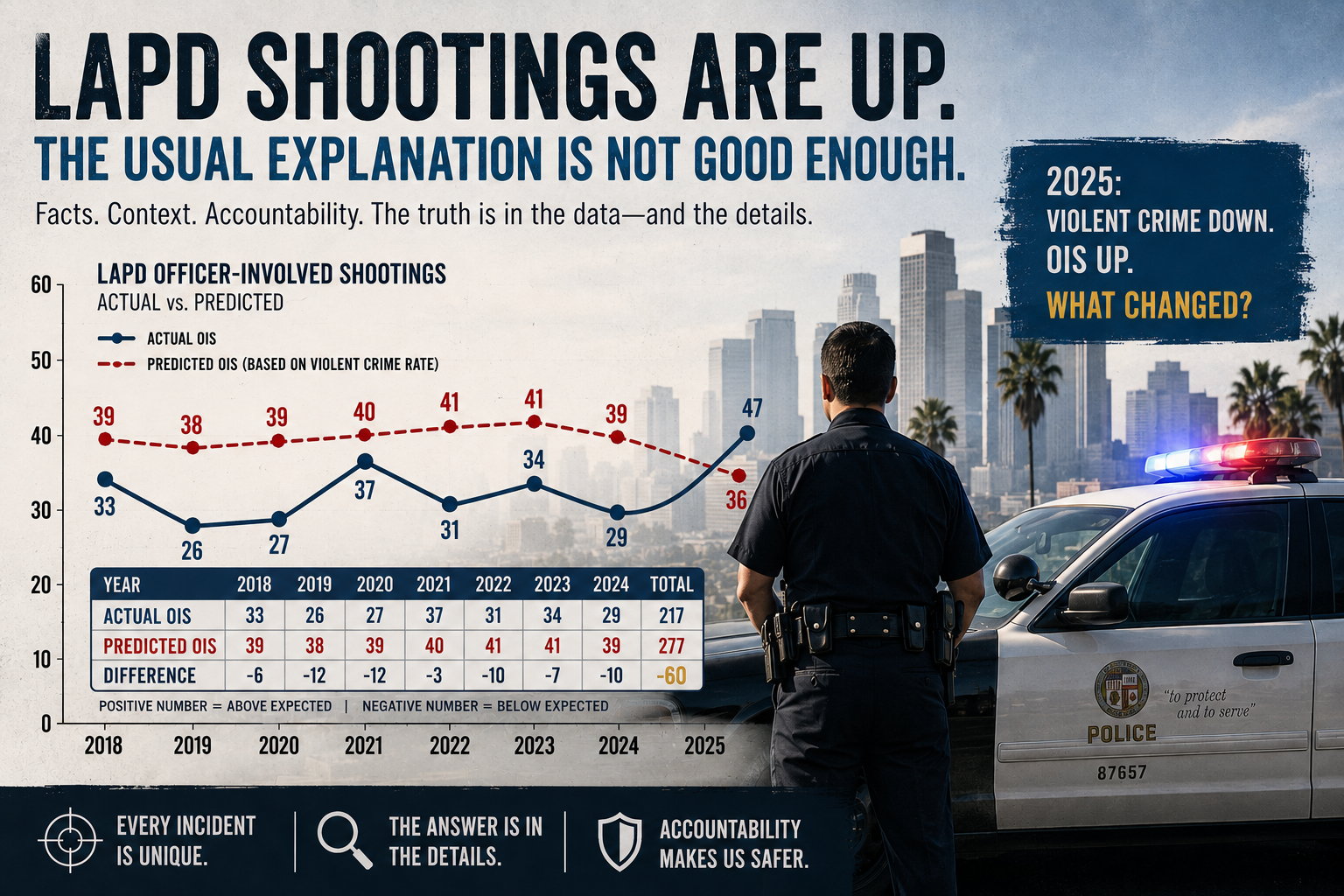
The recent increase in LAPD officer-involved shootings deserves serious public scrutiny. When police shootings rise, the public deserves more than reassurance from the department or slogans from critics. It deserves facts, context and a careful review of what actually happened.
That context matters.
There were 115 officer-involved shootings in Los Angeles in 1990, during one of the highest-crime periods in the city’s history. Yet for more than two decades, annual LAPD OIS totals remained below 50. That reduction did not happen by accident, nor can it be explained solely by lower crime. Even during years when violent crime remained high, LAPD reduced shootings substantially.
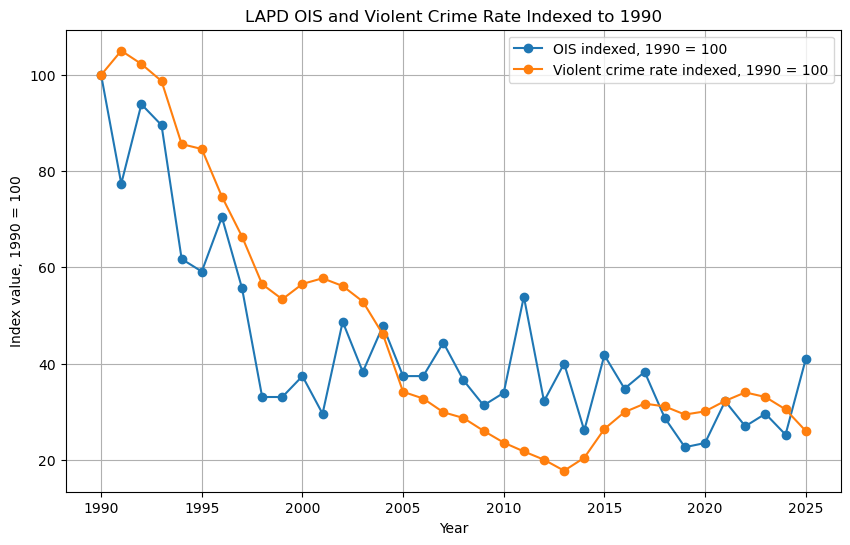
30+ years of OIS and violent crime
To the department’s credit, much of that reduction can be attributed to training, policy changes, improved supervision, tactical review, less-lethal options and a sustained commitment to holding officers accountable for every round they fire. LAPD has lived under intense scrutiny for decades. While that scrutiny has often been uncomfortable, it helped produce a culture in which deadly force is reviewed, questioned and improved.
I have tracked LAPD officer-involved shooting data for many years, including during my 33-year service there. A regression analysis comparing annual LAPD OIS totals with the city’s violent crime rate from 1990 through 2025 shows a strong relationship. Violent crime does not explain everything, but it explains a great deal. In the model, the violent crime rate accounts for approximately 71% of the variation in annual LAPD shootings. For every 100-point increase in the violent crime rate per 100,000 residents, the model predicts roughly three additional OIS incidents.
That matters because LAPD shootings have not moved randomly over time. They have generally risen and fallen with the city’s violent crime environment.
But the recent data show something often overlooked: LAPD was outperforming the model for several years before 2025.
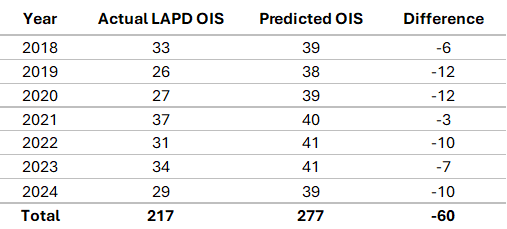
Actual OIS vs Predicted, based on regression analysis
Taken together, from 2018 through 2024, LAPD recorded 217 officer-involved shootings compared with 277 predicted by the violent-crime model — about 60 fewer shootings than expected.
That is not a small achievement. It suggests LAPD’s training, supervision, review process, tactics and less-lethal force options were having a measurable effect. Indeed, the trend happens to correspond with the Department’s 2018 Management-and-Control policy. The department deserves credit for that.
Then came 2025.
In 2025, the violent crime rate declined to 625 per 100,000, one of the lowest rates in the series. Based on that rate, the model predicted approximately 36 LAPD officer-involved shootings. LAPD recorded 47. That is 11 above expected and a clear break from the prior seven-year pattern.
That is the real question: what changed?
The answer will not be found in broad violent crime totals alone. Nor will it be found in slogans, assumptions or agency-to-agency comparisons stripped of context. The only way to understand the 2025 increase is through a full review of each officer-involved shooting.
Every police use-of-force incident is unique. Each must be evaluated on its own facts: what the officers knew at the time, what the suspect did, whether the suspect was armed, and whether the incident involved a firearm, replica gun, edged weapon, vehicle, mental-health crisis, suicidal behavior, foot pursuit, assault on officers or rapidly evolving threat.
Aggregate data can tell us that 2025 was unusual. It can show LAPD had more shootings than expected based on the violent crime rate. But aggregate data cannot tell us whether a specific shooting was justified, preventable, tactically sound or avoidable. That requires disciplined incident-by-incident review.
What should be avoided is the lazy explanation that a sudden spike in police shootings must be the product of racial bias. Bias should never be ignored where evidence supports it. But as an explanation for a sudden one-year increase in a majority-minority police department, it is thin unless someone can identify what changed during the same period. Slogans and ideology are not analysis.
A more plausible hypothesis is that the post-2020 policing environment has changed the character of police encounters.
Much has been said about the “Ferguson effect” or de-policing: the possibility that relentless criticism, political second-guessing and fear of career-ending scrutiny cause officers to pull back from proactive enforcement. That is one side of the problem. The other side should also be acknowledged.
Persistent anti-police rhetoric and demonization may embolden the most committed offenders. Not the average resident. Not the person who calls 911 and cooperates. But the lifelong offender, the armed suspect, the person already inclined to flee, resist, carry a gun or challenge lawful authority.
If that person believes officers are hesitant, unsupported or politically isolated, street encounters can become more dangerous. Officers may intervene too late, when situations are already unstable. Suspects may be more willing to resist. The result can be fewer overall enforcement contacts but more encounters that reach the point of deadly force.
That hypothesis should be tested, not dismissed.
This is not an argument against police accountability. LAPD’s own history shows that accountability, training and review can reduce shootings. But accountability is not the same as reflexive condemnation.
The public deserves more than a raw count and more than a political narrative. LAPD shootings increased in 2025 despite a decline in violent crime. That fact should concern everyone. But the explanation is unlikely to be found in a single accusation. It will be found in the facts of the encounters themselves.
Pasadena Police Video Demands More Than Soft Language
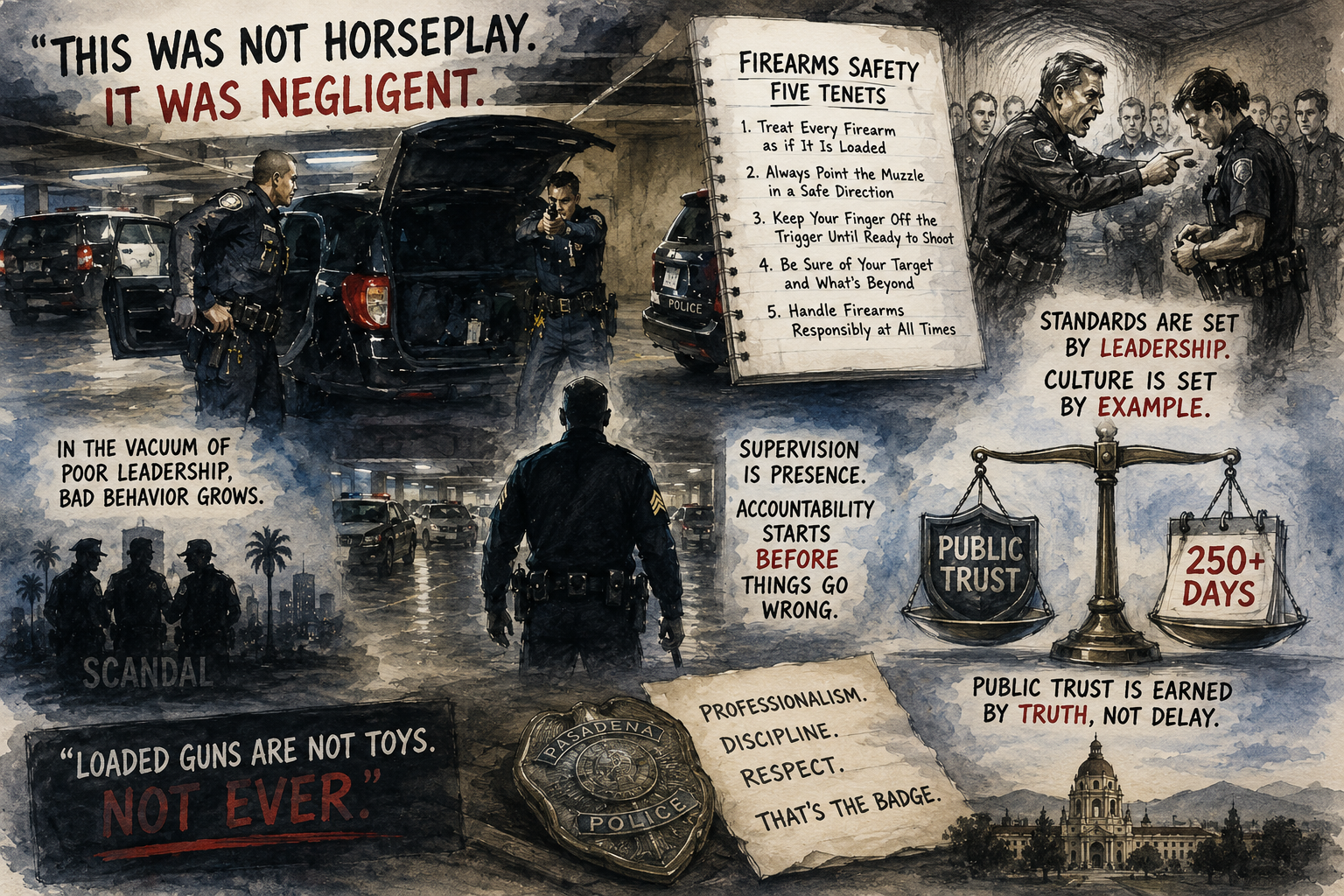
Pasadena Police Video Demands More Than Soft Language
The recently released Pasadena Police Department video of an officer shooting another officer in the department parking structure should trouble the public for reasons far beyond the injury itself.
This was not merely an “accidental” shooting. That word is too soft. Accidents happen when a mechanical defect occurs, when a person trips, or when some unforeseeable event intervenes. What the video appears to show is something more direct and more serious: a negligent discharge involving officers who had no business pointing loaded handguns at one another.
Nor should this be minimized as “horseplay.”
Words matter, especially when they come from a police chief. Calling this “horseplay” may be intended to distinguish the incident from a malicious shooting, but it also risks trivializing what the public is seeing. Horseplay is what boys do in a locker room. It is not what mature, trained, armed police officers should be doing in uniform, at the start of watch, inside a police facility, with loaded weapons.
The better words are plain ones: juvenile, immature, reckless, unprofessional, and worse. At minimum, the conduct shown on the video appears to violate the most basic rules of firearms safety, rules drilled into every police recruit before he or she is ever trusted with a gun.
Treat every firearm as if it is loaded. Always point the muzzle in a safe direction. Keep your finger off the trigger until ready to shoot. Be sure of your target and what is beyond it. Handle firearms responsibly at all times.
These are not advanced tactical concepts. They are the foundation. They are recited so often in police training that they should become reflexive. Violate one of them and you create risk. Violate several at once and the outcome should surprise no one.
What disturbed me most, watching as a retired police captain, was not only the conduct of the two involved officers. It was the apparent absence of shock from another officer nearby when one officer unholstered and pointed his gun toward the officer seated in the car. There is no obvious “What the hell are you doing?” moment. No immediate visible rejection of the behavior. No instinctive shaming of the act.
That matters.
As a young LAPD officer, I once saw an officer jokingly draw down inside the Rampart roll call room. The reaction was instant. Senior officers erupted. The officer drawing his gun was shamed into holstering, and then escorted by a senior officer to the watch commander. There was no committee meeting, no careful wordsmithing, no “boys will be boys” framing. Everyone in that room understood the line that had been crossed and the officers enforced themselves because that was the culture on that matter.
Every profession has conduct that is simply not tolerated. For police officers, pointing loaded guns at one another for amusement is one of those lines.
The Pasadena video also raises a leadership question: where were the sergeants?
Maybe no supervisor could have stopped the initial stupidity. But the broader issue is culture, and culture is built by supervision. In patrol, sergeants cannot lead from behind a desk. They have to be present where officers gather, where cars are loaded, where off-going units check in and on-coming units prepare to deploy.
As a watch commander, I expected a sergeant from the on-coming watch to be in the parking lot after roll call. That sergeant had two jobs. First, check in off-going units, make sure everyone was accounted for, and determine whether overtime was truly necessary. Second, set the tone. Presence matters. Officers behave differently when real supervisors are around. And as the lieutenant, I had to ensure my sergeants followed my expectations on check-in. Some had to be reminded, even scolded. Eventually they all got it.
The check-in process has deep roots in LAPD history. After the Onion Field incident, in which two officers were kidnapped during a night shift and one was murdered, LAPD learned the hard way that accounting for officers is not bureaucracy. It is survival.
There is another lesson from LAPD history. In the 1980s, the Hollywood Burglars scandal exposed a clique of officers who stole from burglary scenes and eventually committed burglaries themselves. One lesson was unmistakable: misconduct grows in a vacuum of poor leadership. The officers later understood which sergeants they could offend around and which ones they could not. Weak supervisors wanted to be liked. Strong supervisors set standards, but they were never disliked. They were respected.
That is the issue here. Not just two officers. Not just one gunshot. Standards and organizational culture.
Chief Gene Harris also owes the public a fuller explanation for the delayed release of the video. California law generally contemplates release of critical incident recordings within 45 days, while allowing delay when disclosure would substantially interfere with an investigation. That authority exists for good reason. Due process matters. Investigative integrity matters.
But so does public confidence.
This incident occurred September 7, 2025. The video was not released until June 10, 2026. That is more than 250 days later. For a video showing uniformed officers engaging in reckless gun handling inside a police facility, the public deserved a stronger and earlier message. The department also deserved one.
I understand the officer who fired the round has been terminated. I do not know when that decision was made. But if it were made soon after the incident, it would have sent a needed message of decisiveness and courage.
Whenever that date was, the termination itself matters. It represented a judgment by the department that the conduct was serious enough to end an officer’s career. And in my view, it was the right judgment.
That also raises the harder question: once the department reached that conclusion, what reason remained to delay release of the video? Due process and investigative integrity are legitimate concerns. But termination is not a neutral administrative step. It is a final, serious judgment about conduct. Once that judgment had been made, the public deserved to see the video and hear from the department plainly, directly, and without euphemism.
Leadership is not waiting until criticism is unavoidable. It is acting quickly, deliberately, and without fear of public reckoning. It is telling the community, and the officers who still wear the badge, that pointing loaded handguns at fellow officers is not horseplay. It is a firing offense.
The chief’s statement says this conduct is not consistent with the standards of the department. Good. But that statement would have carried more weight months ago, accompanied by decisive visible action and language that matched the seriousness of what occurred.
The people of Pasadena should not be left with euphemisms. This was not horseplay. It was a negligent shooting born from a collapse of firearms discipline and professional judgment. The video should prompt more than embarrassment. It should prompt hard questions about supervision, culture, accountability, and whether Pasadena police leadership is willing to say plainly what every firearms instructor already knows:
Loaded guns are not toys. Not ever.
Sacramento Deserves Better Than Advocacy Math on Police Stops
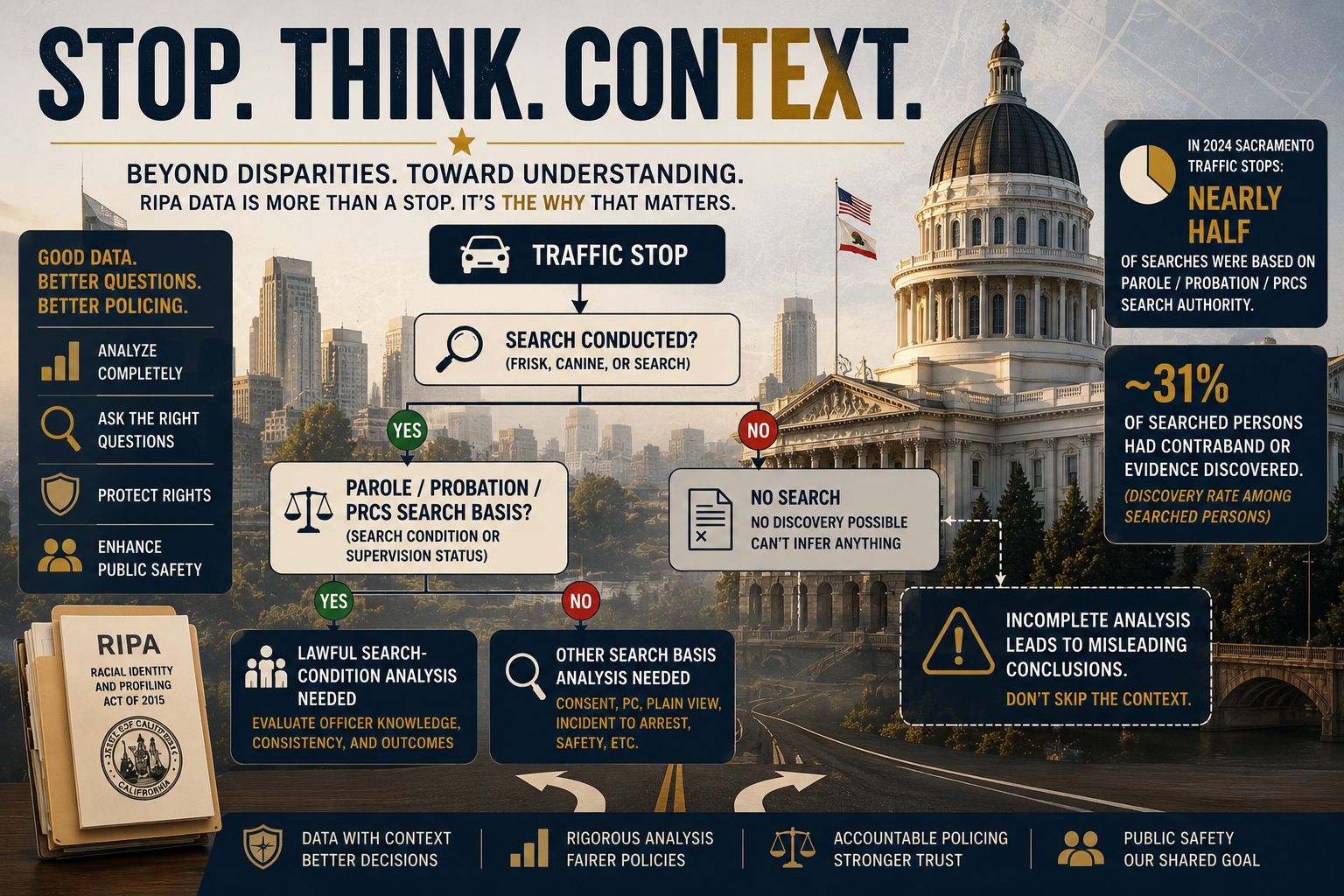
The ACLU’s recent report on Sacramento police traffic stops presents itself as data analysis, but its conclusion is advocacy dressed in statistical clothing. The report claims Sacramento police use minor traffic violations as racial pretexts to stop and search Black and Latino drivers, and it urges the city to prohibit many of those stops. That is a serious charge. It deserves serious analysis.
This report does not provide one.
The ACLU points to real disparities. Black drivers are stopped and searched at higher rates than White drivers. Black drivers are also more represented in equipment and non-moving violation stops. Those facts deserve scrutiny. But disparity is not, by itself, proof of racial profiling. It is the beginning of the analysis, not the end.
The report’s biggest failure is that it does not adequately explain why searches occurred. RIPA data does not merely tell us whether a person was searched. It also records the reported basis for the search, including parole, probation, PRCS, or mandatory-supervision search conditions. That matters enormously.
In Sacramento’s 2024 traffic-stop data, nearly half of all search, frisk, or canine-search records listed parole/probation/PRCS/mandatory supervision as a basis for the search. That single factor explains a large part of the elevated search rate for Black stopped persons. It does not prove every search was proper. It does not answer whether officers asked about supervision status evenly across racial groups. But it absolutely changes the question.
The question is not simply, “Why are Black drivers searched more?” The better question is, “How many searched persons were subject to lawful search conditions, and how did officers come to know that?” The ACLU largely skips that question.
The report also mishandles discovery rates. It emphasizes that 90% of searches resulted in “no items seized,” then uses that number to suggest traffic-stop searches rarely find contraband. But “no items seized” is not the same as “nothing was discovered.” RIPA separately records contraband or evidence discovered and property seized. Firearms, ammunition, weapons, drugs, alcohol, money, drug paraphernalia, stolen property, electronic devices, and other evidence are discovery categories; seizure is a separate issue. The ACLU’s own report relies heavily on “no items seized” to argue searches have little value.
That is misleading.
A discovery rate should be calculated only among stops where officers actually searched, frisked, or used a canine. You cannot count a non-search as a failure to discover contraband. No one looked. No search occurred. In the 2024 Sacramento traffic-stop data I reviewed, 2,575 records involved a search, frisk, or canine search. Contraband or evidence was recorded in 808 of those records — about 31%. That is not “almost never.” It is roughly one discovery for every three searched persons.
That number matters because the policy debate is not cost-free. The popular movement to reduce police stops or prohibit pretext stops treats traffic enforcement as if it has only one effect: inconvenience or harm to motorists. That is not reality. Traffic stops also deter crime. They raise the perceived risk for people driving around with guns, drugs, stolen property, warrants, or parole and probation search conditions.
I saw this dynamic firsthand.
From 2019 to 2021, I served as chief crime analyst for the Los Angeles Police Department. During that period, following the George Floyd demonstrations and rioting, violent crime, shootings, and homicides rose dramatically. At the same time, political decisions reduced police presence and proactive activity in parts of Los Angeles where violent crime was already concentrated, especially South Los Angeles. Police stops dropped sharply — by roughly half — in the months and years that followed.
Some argued the rise in shootings was caused by more guns being stolen from homes. I researched that theory at the time. I did not find evidence that more guns were being stolen in 2020 than the year before. What I did find was more troubling: gun seizures from car stops increased more than 30% even as total car stops dropped. In plain English, fewer cars were being stopped, but more guns were being found in the cars that were stopped.
That suggests something important: more people were driving around armed.
I also found that much of the increase in shooting victims was not simply because there were vastly more shooting incidents. A major share of the increase was driven by shootings with multiple victims. That reflected a behavioral shift. The traditional “spray-and-pray” drive-by shooting, where hitting the intended target was often uncertain, became less common. More shootings became walk-ups. A shooter who walks up on a target has a better chance of hitting him, a better chance of killing him, and a greater incentive to shoot others nearby who might be witnesses or might return fire.
Why would that change happen? In my judgment, offenders understood the environment had changed. Fewer police. Fewer stops. Less visible enforcement. Lower perceived risk.
That is deterrence in reverse.
When policymakers reduce police stops, they may reduce unpleasant encounters for law-abiding drivers. That benefit is real. But they may also reduce the perceived risk for armed offenders moving through the city. That cost is also real. The ACLU report barely acknowledges it.
None of this means Sacramento police should have unlimited discretion. They should not. If officers are using minor violations as dishonest excuses to investigate people based on race, that should be exposed and stopped. But proving that requires more than comparing stop counts to residential demographics and declaring racism. City population is a weak benchmark for traffic stops. Drivers on Sacramento streets include commuters, visitors, delivery drivers, rideshare drivers, people passing through commercial corridors, and people under criminal justice supervision.
A serious audit would separate traffic stops by violation type, location, time of day, call-for-service status, passenger status, search basis, supervision status, discovery, seizure, and outcome. It would distinguish consent searches from parole/probation searches, officer-safety frisks, inventory searches, searches incident to arrest, and searches based on visible contraband. It would ask whether officers are asking about parole or probation status at different rates by race. It would not pretend “no seizure” means “no discovery.”
The ACLU report identifies disparities. That is useful. But then it leaps from disparity to motive, from motive to civil-rights violation, and from civil-rights violation to a sweeping policy demand.
Cities like Sacramento and Los Angeles deserves better than that.
The real question is not whether racial profiling should be tolerated. It should not. The real question is whether California police agencies can reduce improper stops without dismantling one of the few tools officers have to find guns, locate wanted persons, enforce lawful search conditions, and deter armed offenders before the next shooting.
That is the public-safety tradeoff. The ACLU’s report avoids it. The city councils should not.
Pasadena’s Police Oversight Commission Has a Credibility Problem
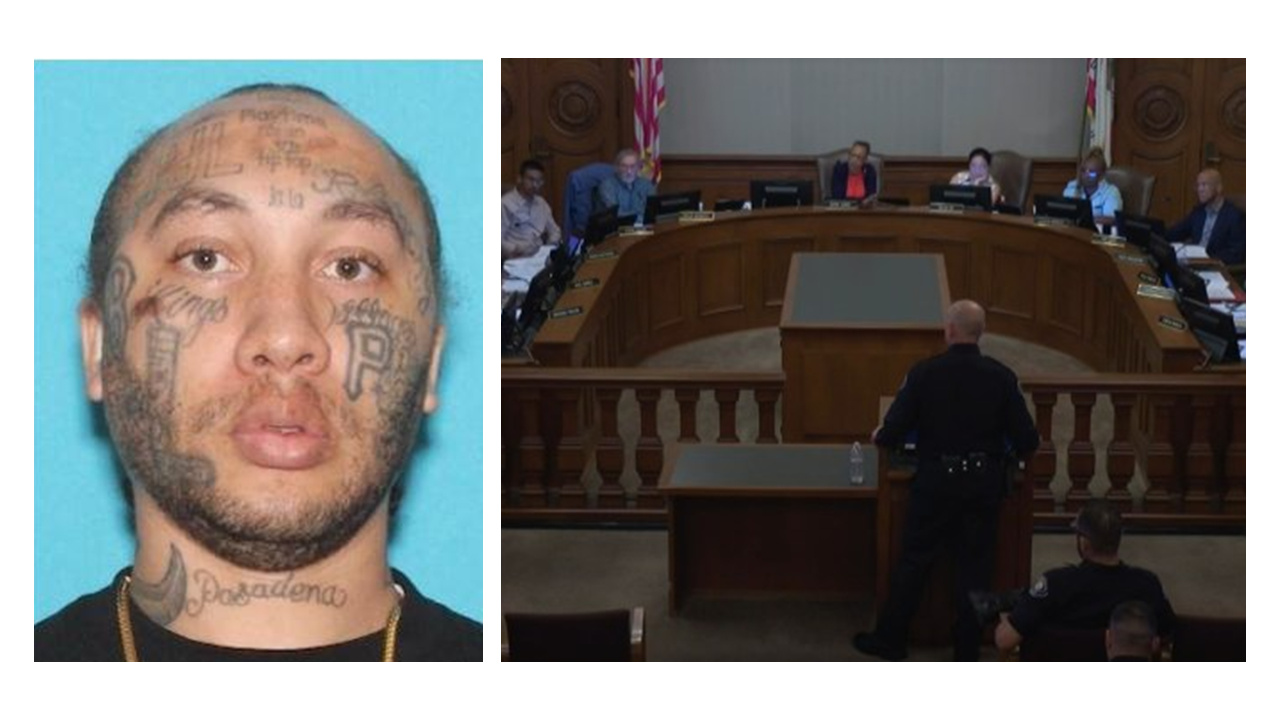
Malcolm Buchanan Pasadena Comm. Police Oversight Cmsn
Pasadena’s Community Police Oversight Commission was not created to be an anti-police advocacy group. It was created, according to the City’s own description, to “enhance, develop, and strengthen community-police relations,” and to review and make recommendations regarding police department operations. That is a serious public mission. It requires independence, fairness, restraint, and judgment.
The recent officer-involved shooting involving Malcolm Buchanan is a test of whether the commission still understands that mission.
After reading Pasadena Now’s May 15 article and watching the newly released critical incident video, I came away with a question that should concern every Pasadena resident: what exactly is the city getting from this commission if its most vocal members appear to undermine police legitimacy even in a case where officers were responding to an armed suspect who had already shot one person and then shot a police officer?
This was not a random police contact. Officers were dispatched on March 2 to a reported shooting at the Sierra Madre Villa Metro Station. According to Pasadena Police, an arriving officer contacted a gunshot victim and obtained a suspect description. A second victim reported that the first victim had been shot while trying to intervene in a sexual assault. Officers later found someone matching the suspect description a few blocks away. When they attempted to detain him, he fled. During the foot pursuit, officers gave commands to stop. The suspect did not comply. An exchange of gunfire followed, leaving Officer Bryan Vasquez seriously wounded and Buchanan dead.
Pasadena Now reported that Officer Vasquez suffered life-threatening injuries, underwent surgery, spent weeks recovering at Huntington Hospital, and continued to receive medical treatment after being discharged. The case remains under criminal and administrative review.
Those facts should matter.
They should matter before anyone implies racism. They should matter before anyone suggests police malfeasance. They should matter before anyone turns an armed suspect into a symbol and the wounded officer into an afterthought.
Yet Pasadena Now reported that, at the May 14 commission meeting, Chair Esprit Loren Jones said she had attended Buchanan’s memorial service and repast. She also said Buchanan’s mother, grandmother, and father told her they had no contact from the department during the first 45 days. Jones said she had concerns but would save the issue for a later conversation.
Concerns about communication with a deceased person’s family may be fair game. But context matters. Chief Eugene Harris reportedly told the commission that the department issued a letter about the delay, contacted Buchanan’s family, and showed the critical incident video to involved officers and family members, including Buchanan’s family, before public release.
So what exactly is the “issue” of great concern?
A man was shot. Police were called. A suspect description was given. Officers found a man matching that description. He was armed. He ran. A police officer was shot and nearly killed. Officers returned fire. The suspect died.
If the commission chair’s public concern is that the family of the armed suspect felt insufficiently contacted, that issue may be worth clarifying. But it cannot be treated as morally equivalent to the actual sequence of public danger that brought police there in the first place. Nor should the chair of the city’s police oversight body appear publicly aligned with the family narrative of a man who shot a police officer before the investigation is complete.
Compassion is not the problem. A family can grieve even when their loved one did terrible things. Mental illness may help explain behavior, but it does not erase the threat Buchanan posed that night. The police officer did not have the luxury of conducting a clinical diagnosis during a foot pursuit involving an armed shooting suspect. He had a duty to protect the public. Based on the video and public reporting, he attempted to do exactly that --- and was nearly killed for it.
That is why the optics of the commission chair attending Buchanan’s memorial service matter. Not because private compassion is forbidden. Not because the dead man’s family should be treated cruelly. But because public officials with oversight authority must avoid the appearance of prejudgment. When a commission chair appears closer to the family of the suspect than to the wounded officer or the public endangered by the suspect’s actions, the commission’s neutrality suffers.
If the commission chair believed it was appropriate to attend Buchanan’s memorial service and repast, one wonders whether she made any comparable effort to visit Officer Vasquez in the hospital or express concern to his family. Perhaps she did. If so, the public should know that. But if the only visible gesture of personal solidarity went toward the family of the man who shot the officer, then the problem is not compassion. The problem is imbalance.
And neutrality is the whole ballgame.
A fair police oversight system should do two things at once: hold officers accountable when misconduct is proven, and protect them when false, exaggerated, or unsubstantiated accusations are used to destroy reputations. The ugly truth is that some civilians do make knowingly false complaints. Others make mistaken ones. Some complaints are driven by anger, leverage, politics, or litigation strategy. If a civilian review board helps push stigmatizing claims into public view without adequate proof, that is not transparency. It is reputational punishment without due process.
The same problem exists when commissioners treat disparity as proof of discrimination. RIPA data can identify patterns worth examining. It can raise questions. But it does not, by itself, prove racial animus by officers. Yet in Pasadena, discussions of police stops too often seem to begin from the assumption that disparity equals racism and police activity is inherently suspect.
I saw that problem firsthand during my brief tenure on the commission. At one meeting, a professor presented a taxpayer-funded report that implied Pasadena police were engaging in disparate treatment toward Black and Hispanic residents. The report magnified a disparity by an order of ten. When I questioned the math, he answered, “Oh, I guess you read the report,” and admitted the error. But the error was never publicly corrected with the same visibility as the original accusation.
That matters. Public perception is shaped by official-sounding presentations, headlines, commission discussions, and selective outrage. When the accusation is loud and the correction is silent, the damage remains.
This problem also predates the Buchanan shooting. When I joined the commission as a retired LAPD officer, Pasadena Now reported that Chair Jones remarked, “We’ve got a groove that is being a bit disrupted.” A public commenter said, “I’m definitely keeping my eyes on you. I know you’re LAPD retired.” In isolation, perhaps those comments could be brushed off as ordinary skepticism. In context, they reflect a deeper problem: law enforcement experience was treated less like useful knowledge and more like contamination.
That attitude is poisonous if the commission’s mission is truly to strengthen community-police relations.
Police officers can accept scrutiny. They live with scrutiny every day: body cameras, supervisors, internal affairs, prosecutors, civil litigation, media coverage, public records laws, and now civilian oversight. What they should not have to accept is a city-sponsored process in which some commissioners appear to approach police work with open cynicism and ideological suspicion.
That has a cost.
It costs morale. It costs recruitment. It costs retention. It costs public safety when officers begin to wonder whether the city they serve will stand behind them even when the facts show they acted courageously. It costs taxpayers when litigation is encouraged by public officials who seem eager to validate one side before the investigation is complete. And it costs social cohesion when residents are repeatedly told, directly or indirectly, that their police department is racist, corrupt, or murderous without proof.
Oversight done well is valuable. Oversight done poorly is worse than useless. It inflames distrust while claiming to build trust. It demoralizes officers while claiming to improve policing. It gives activists a platform while giving the public the illusion of balanced review.
Pasadena does not need a commission that reflexively defends the police. That would defeat the purpose. But it also does not need one that reflexively distrusts them.
The city needs commissioners credible enough to criticize officers when they are wrong, disciplined enough to wait for facts before implying wrongdoing, and honest enough to defend officers when the evidence shows they acted lawfully and bravely.
The Buchanan shooting should have been a moment of moral clarity. A wounded victim. A fleeing armed suspect. A police officer nearly killed in the line of duty. A tragic death, yes, but one caused by a chain of violent conduct that officers were duty-bound to confront.
If Pasadena’s oversight commission cannot distinguish that from police misconduct, then the city has a bigger problem than one controversial meeting.
It has an oversight commission that may no longer be serving the purpose for which it was created.
Good outcomes are built long before the moment of truth
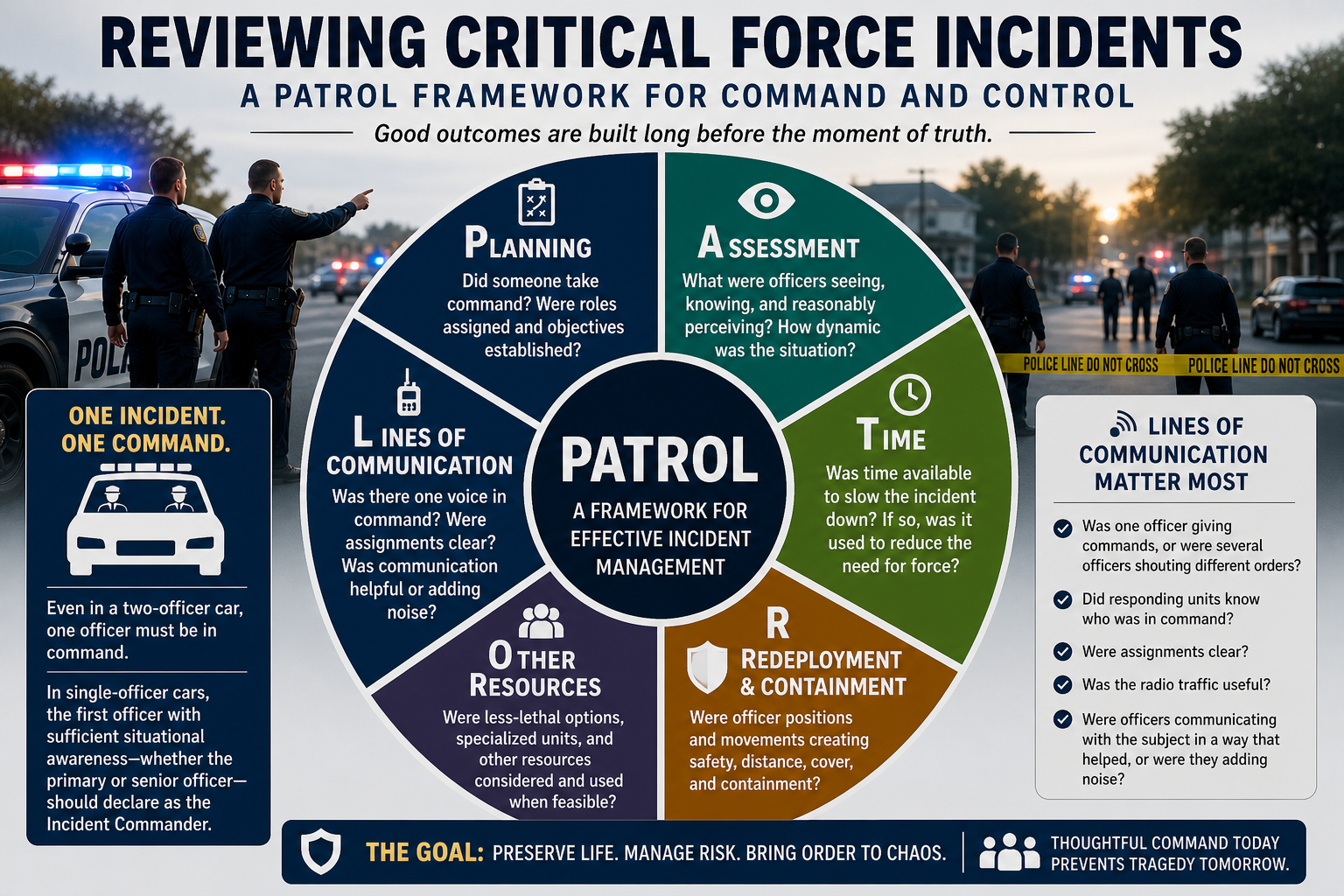
Design based on LAPD training bulletin concepts
Reviewing Critical-force Incidents
Across the country, the review of police deadly force is moving beyond the old question of whether an officer faced danger at the precise instant force was used. California has already codified that movement. Penal Code section 835a now states that deadly force should be used only when necessary, in defense of human life, and officers are expected to consider available resources and techniques when reasonably safe and feasible.
The courts are moving in the same direction. In Barnes v. Felix, the United States Supreme Court rejected the narrow “moment of threat” rule, holding that Fourth Amendment force reviews must consider the totality of the circumstances, including relevant events leading up to the use of force. California reached a similar destination under state negligence law in Hayes v. County of San Diego, where the California Supreme Court held that liability may arise from tactical conduct and decisions preceding deadly force if, under the totality of the circumstances, those decisions made the use of force unreasonable.
That does not mean every bad outcome is proof of bad tactics. It does mean reviewers should resist the old habit of looking only at the final seconds.
The Los Angeles Police Department’s Command and Control training bulletin offers a practical way to conduct that broader review. The bulletin defines Command and Control as active leadership used to direct personnel, coordinate resources, accomplish tasks, and minimize risk. It also identifies PATROL as a tool for establishing Command and Control: Planning, Assessment, Time, Redeployment and/or Containment, Other Resources, and Lines of Communication.
Planning asks a basic question: did anyone take charge? In a critical incident, planning may be imperfect and compressed. Nobody should expect a field officer to produce a conference-room strategy while a person is armed, unstable, or violent. But there still needs to be direction. Who identified the problem? Who assigned roles? Who decided whether officers should hold, move, contain, communicate, evacuate, or deploy less-lethal options? A scene full of officers is not the same thing as a managed response.
Assessment requires reviewers to look at what officers knew, what they reasonably perceived, and what they should have been processing as the incident unfolded. Was the subject armed? Was the weapon being used against others, displayed, concealed, or merely reported? Were there victims nearby? Was the person suicidal, assaultive, fleeing, barricaded, or confused? Were officers dealing with a static problem or a rapidly deteriorating one? Good assessment is not hindsight. It is disciplined attention to the facts available at the time.
Time may be the most misunderstood factor. Time is valuable when it exists. It allows officers to slow the pace, create distance, bring in supervision, establish communication, deploy less-lethal tools, and reduce confusion. But time is not always available. A suspect actively stabbing someone, pointing a firearm, or closing distance with a deadly weapon can collapse decision-making into seconds. The fair question is not, “Could officers have waited?” The better question is, “Was time reasonably available, and if so, did officers use it to reduce the need for force?”
Redeployment and containment focus on officer positioning. Did officers move to cover? Did they create distance? Did they avoid crowding the subject? Did they contain movement and protect the public? Poor positioning can manufacture urgency. Better positioning can lower the temperature. It can also reduce the number of officers who believe they must use deadly force at the same time.
Other resources asks whether officers considered the tools and personnel available to them. That may include less-lethal options, shields, K-9, air support, crisis negotiators, mental health teams, additional supervisors, medical personnel, or specialized units. But resources are not magic either. They must be feasible, timely, and relevant. Calling for a resource that cannot arrive in time may look good in a report, but it may not change the reality on the ground. By contrast, when a resource is reasonably foreseeable, available, and important to a planned event, failing to secure it may be a legitimate basis for critique.
Lines of communication are often where incidents succeed or fail. Command does not begin when a supervisor arrives; it begins when someone on scene takes responsibility for organizing the response. Even in a two-officer patrol car, one officer needs to function as the lead voice. In single-officer deployments, the first officer with sufficient situational awareness — whether the primary officer or the senior officer present — should clearly establish who is managing the incident until relieved. Was one officer giving commands, or were several officers shouting different orders? Did responding units know who was in command? Were assignments clear? Was the radio traffic useful? Were officers communicating with the subject in a way that helped, or were they adding noise?
PATROL does not turn force review into a search for perfection. Police officers still face dangerous, unstable, and fast-moving events. Some uses of deadly force are necessary despite sound tactics.
But PATROL does force the right questions. Was there leadership? Was there assessment? Was time used when available? Were officers positioned wisely? Were resources considered? Were communications clear?
That is the proper direction of modern police force review. Good outcomes are built long before the moment of truth.
Do Police Tactics Leading Up to Force Matter?
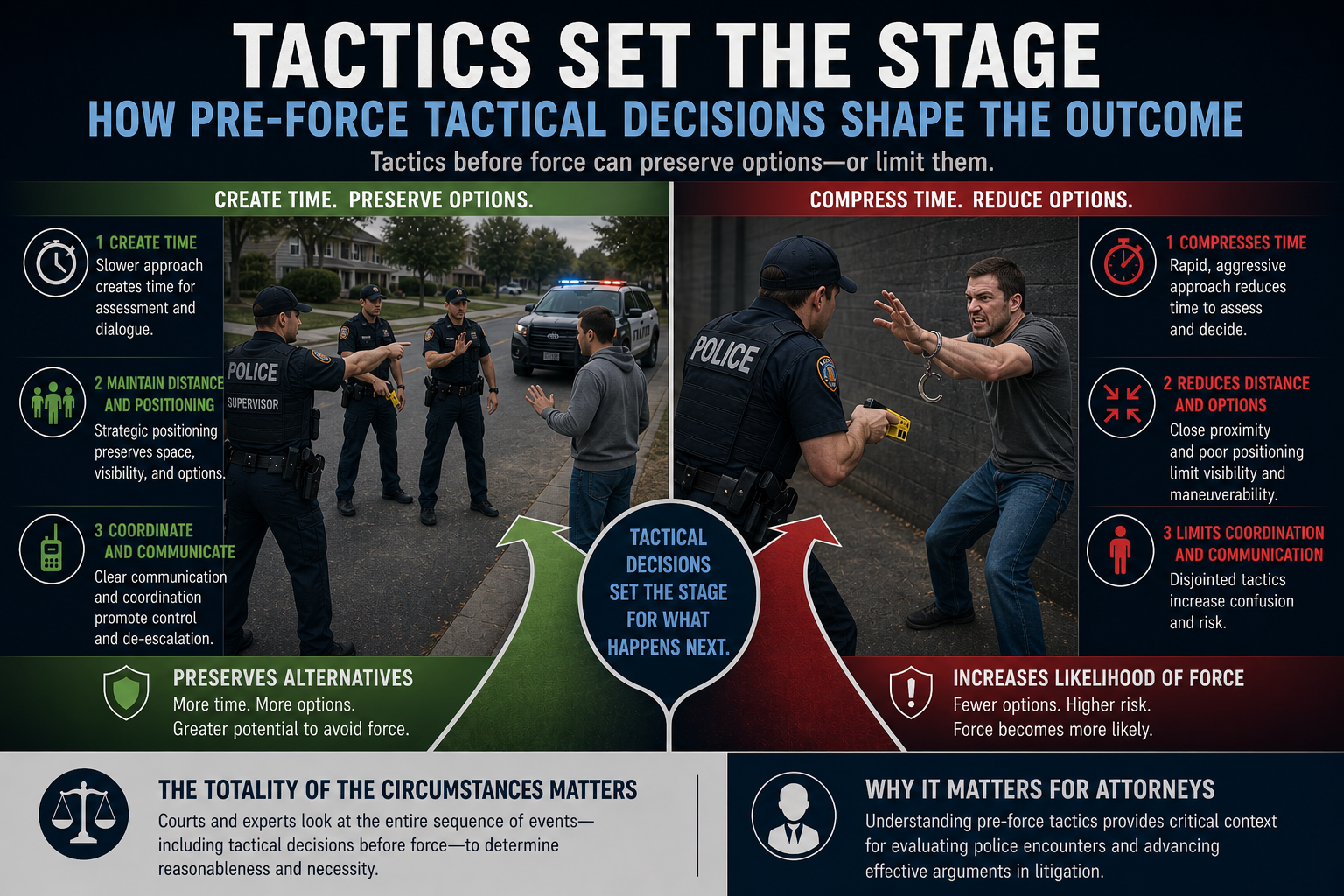
Police use-of-force analysis often focuses on the moment force is applied. However, the events leading up to that moment can play a significant role in how an encounter unfolds.
Tactical decisions such as approach speed, positioning, coordination, and containment can either create time and control or compress the encounter and reduce available options. When time and distance are limited, officers may be required to make rapid decisions under uncertain conditions.
In some cases, these tactical choices can influence whether force becomes necessary. A controlled approach may preserve alternatives, while a compressed encounter may increase the likelihood that force will be used.
Courts and experts increasingly examine the totality of the circumstances, including these pre-force decisions. As a result, the analysis of tactics is often central to understanding both the reasonableness and necessity of force.
For attorneys, this broader perspective provides a more complete understanding of how police encounters develop and how they are evaluated in litigation.
Can Police Force Be Reasonable but Still Unnecessary?
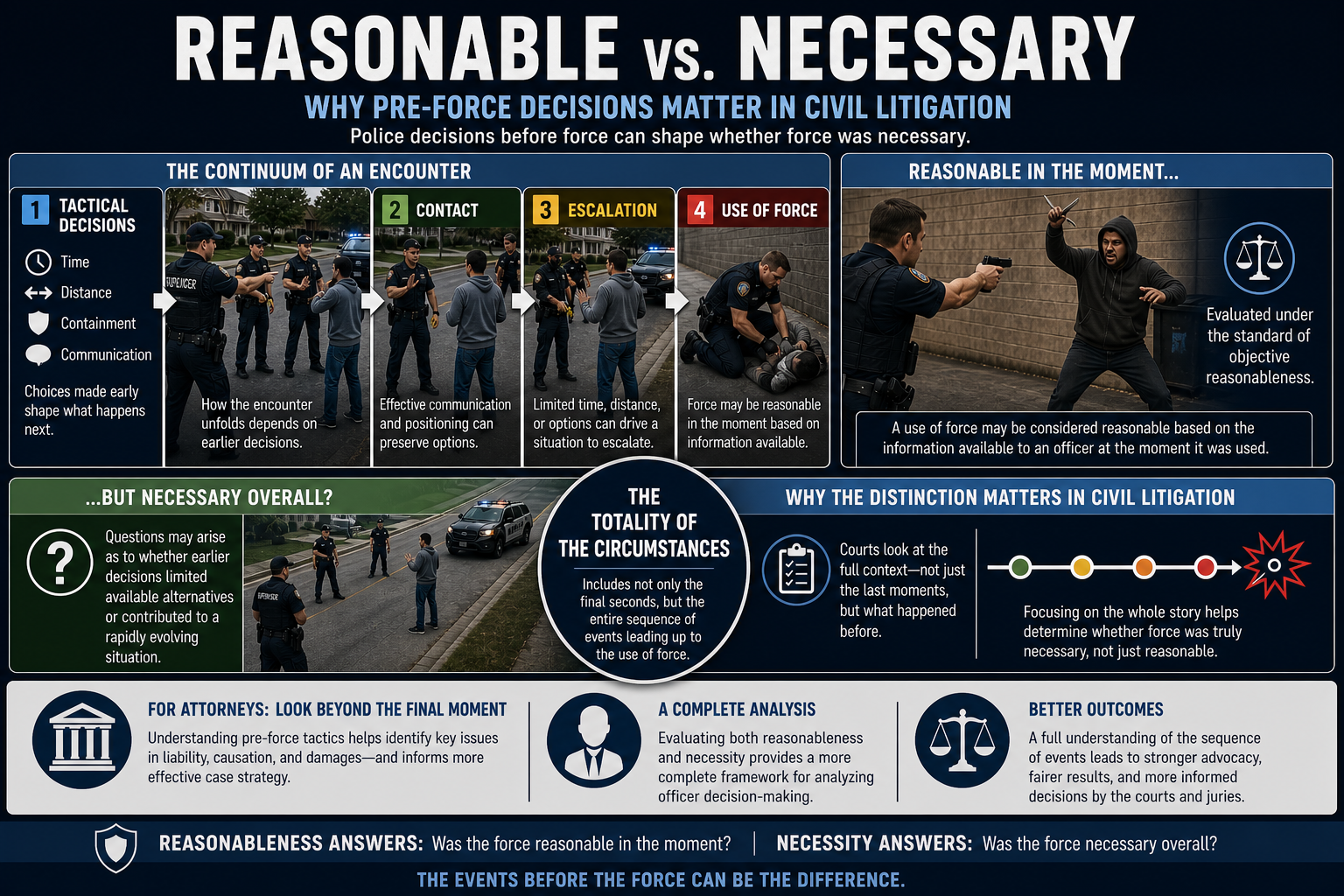
Police use of force is often evaluated under the standard of objective reasonableness. However, an increasingly important question in civil litigation is whether the force used was not only reasonable, but necessary.
In many cases, the analysis does not begin at the moment force is applied. It begins with the tactical decisions that led up to the encounter. Decisions involving time, distance, containment, and communication can shape whether a situation escalates into a use-of-force event.
A use of force may be considered reasonable based on the information available to an officer at the moment it was used. At the same time, questions may arise as to whether earlier decisions limited available alternatives or contributed to a rapidly evolving situation.
This distinction is particularly relevant in civil cases, where the totality of the circumstances includes not only the final seconds, but the sequence of events leading up to the use of force.
For attorneys evaluating these cases, understanding both reasonableness and necessity provides a more complete framework for analyzing liability and officer decision-making.
Policing Is Thinking
Part I: How closing car doors can prevent pursuits, shootings, and avoidable uses of force
Ken Aston, the legendary soccer referee, once said, “Refereeing is thinking.”
He meant that good refereeing is not merely reacting after the foul. The best referees read the game. They study body language. They sense frustration building. They recognize trouble before it happens and take small steps early to keep the match from becoming unmanageable.
The same is true in policing: Policing is thinking.
Good police work is not simply reacting to danger after it appears. It is evaluating what is happening, sizing up what may happen next, recognizing complications before they develop, and taking reasonable steps to keep a manageable situation from becoming a crisis.
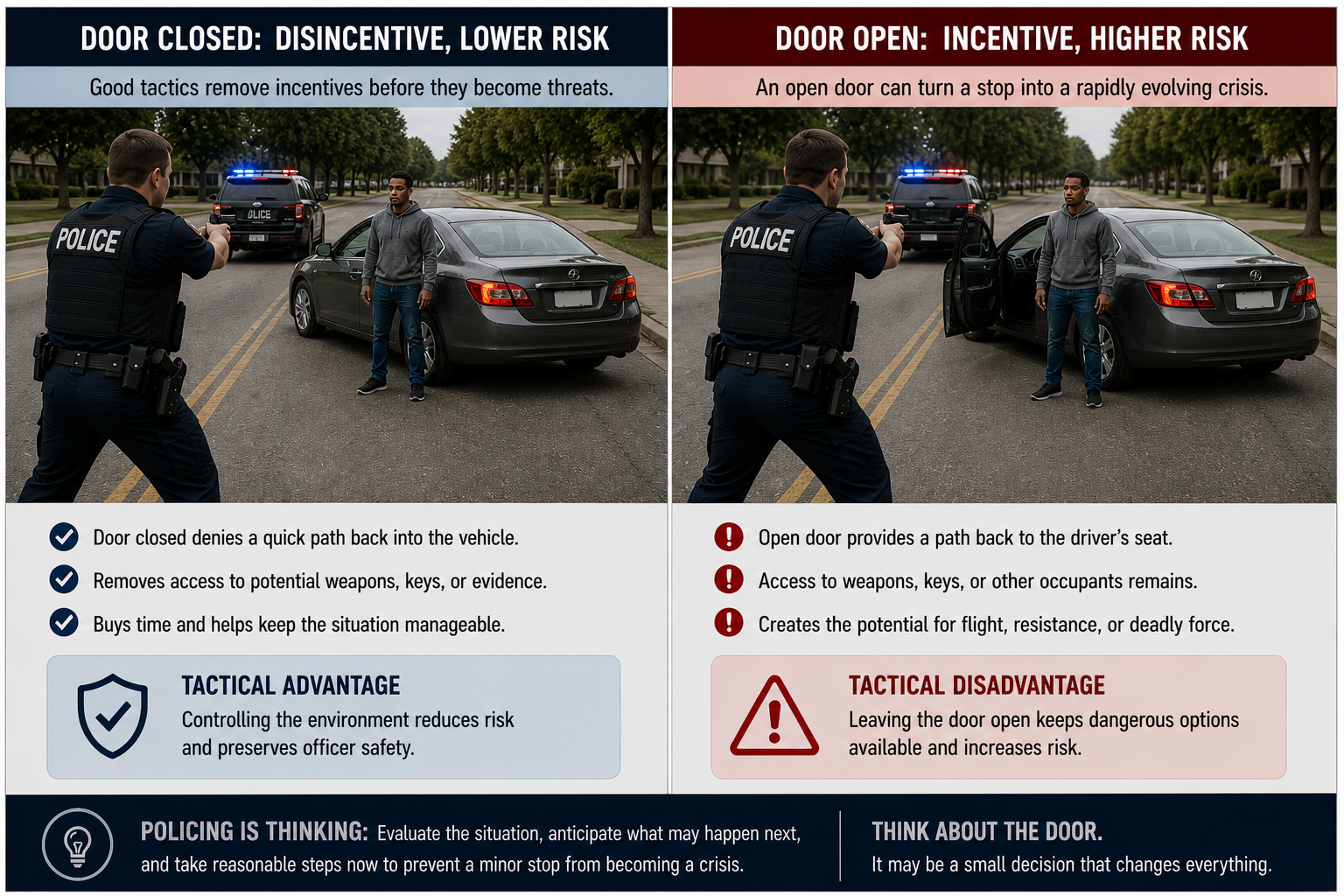
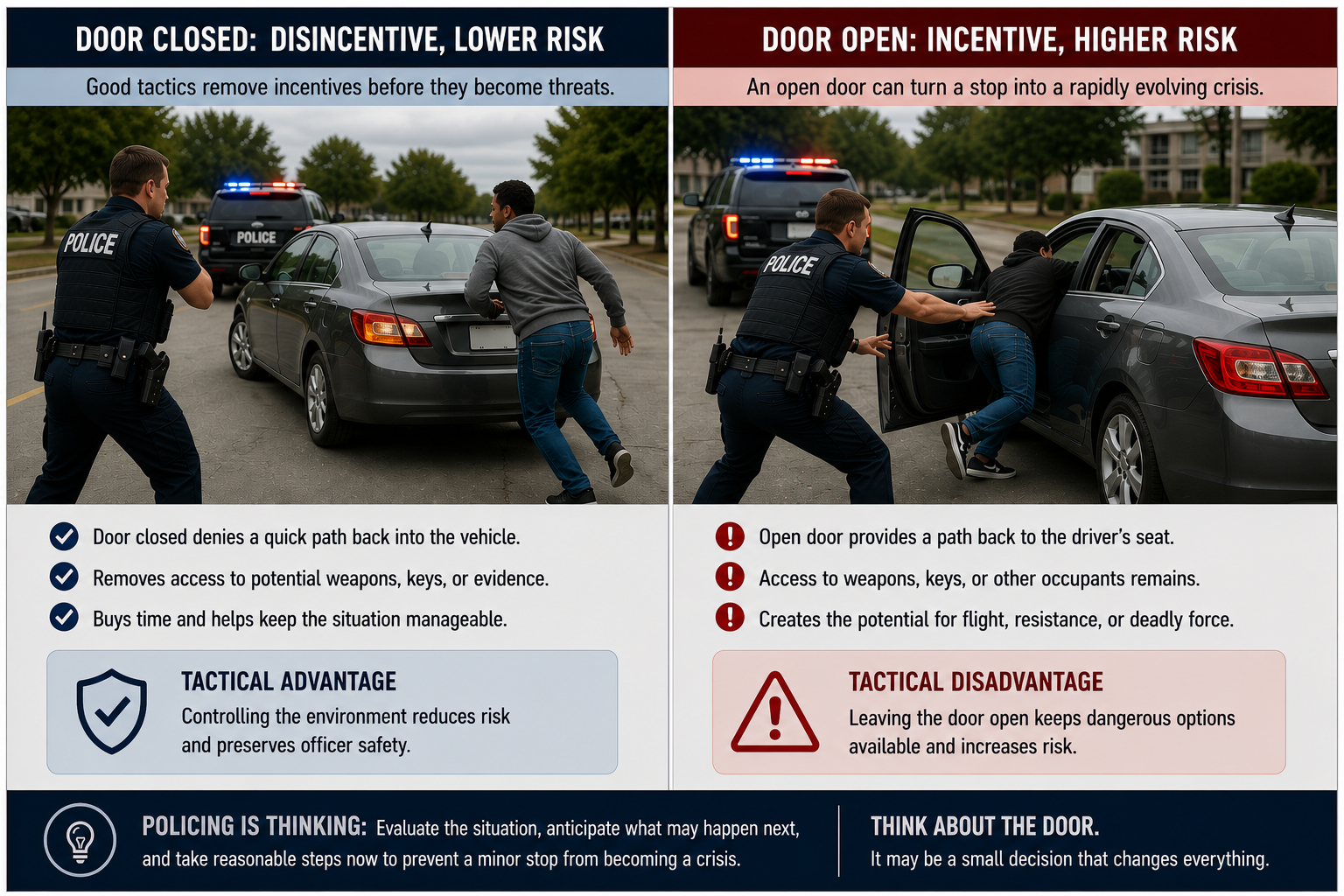
One simple traffic-stop tactic deserves serious discussion: when a driver or passenger is removed from a vehicle, officers should consider getting the door closed behind that person, as long as it is safe and lawful to do so.
The open-door problem
Officers are trained to watch hands, maintain distance, use contact-and-cover, avoid crossfire, and control positioning. Those principles matter. But the vehicle itself can become the central problem.
A vehicle is not just transportation. During a traffic stop, it may also be a source of weapons, a means of escape, a place to conceal evidence, a barrier, or a weapon.
Two police shootings will illustrate my point, but they are only two of dozens across the country.
Daunte Wright: a minor stop that became a deadly-force incident
The death of Wright in Brooklyn Center, Minnesota, illustrates the issue.
Daunte Wright was stopped for traffic and equipment violations in Brooklyn Center, MN, in 2021. During the stop, officers learned he had an outstanding warrant and attempted to arrest him. Wright resisted, broke away, and got back into the driver’s seat through the left open door. The senior officer said she intended to use her Taser but fired her handgun instead, killing Wright. She was later convicted of manslaughter.
No one can honestly say closing the door would have prevented the shooting. But the case shows how quickly a relatively minor traffic stop can collapse once a noncompliant driver has a path back into the vehicle.
Once Wright got back into the driver’s seat, the situation shifted from arrest-and-control to possible vehicle flight, a moving car, and a rapidly collapsing tactical situation.
A closed door could have changed the timing and trajectory of the encounter. It might have made reentry harder. It might have bought time. It might have defeated Wright’s impulse or incentive to resist.
Policing is thinking means recognizing that the open door is not neutral. Open, it gives the driver an option. Sometimes that option becomes the whole case.
Russell Douthit: when the vehicle remains a threat
A 2022 LAPD Harbor Division shooting presents a different but related problem.
Two LAPD Harbor Division officers detained a car in San Pedro containing four occupants outside a liquor store. Russell Douthit was seated in the left rear passenger seat. After establishing reasonable suspicion, officers removed occupants one at a time. When an officer ordered out Douthit, he left objects on the seat. During a pat-down, the officer recovered a loaded handgun from Douthit’s waistband.
At that point, the tactical situation changed. Having found one gun, with another passenger still in the car, the officer stopped searching, backed away, and requested backup.
The officers ordered Douthit to his knees near the open rear door. He was not handcuffed. Officers gave him commands to move away from the passenger compartment. Instead, Douthit lunged into the back seat with both hands and came back out holding a dark object. An officer fired one round, striking Douthit in the hand. The object turned out to be a cell phone. The District Attorney later found the shooting justified. No argument there.
The point is tactical
Once a handgun had been recovered from Douthit’s waistband, the officers were in a high-risk situation, waiting for backup. Because the door issue had not been closed when Douthit was removed, it was now too late to address it safely. Douthit was not handcuffed, within arm’s reach of the open car, and only he knew what was in the back seat. One gun has already been removed from his waistband.
A closed door could have changed the encounter. At minimum, it would have slowed or limited Douthit’s ability to reenter the vehicle.
The facts in the two cases are different, but the lesson is the same: the vehicle is not neutral if the suspect can still get into it.
Best practice: close the door
When a driver or occupant is lawfully directed out of a vehicle, officers should consider instructing that person to close the door behind him, assuming it can be done safely.
Good tactics often work by removing options before they become threats.
Not every door in every case must be closed. Tactics are situational. Sometimes an officer may want the door open to see inside the vehicle. Sometimes he may need to preserve evidence, monitor another occupant, or avoid putting the suspect’s hands near the door. Sometimes closing the door creates a worse problem than leaving it open.
So, the point is not: always close every door.
The point is: think about the door.
What does the open door give this person? Can he get back into the driver’s seat? Are the keys in the vehicle? Can he reach a weapon? Can he reach property, clothing, or a phone that may complicate the encounter? Can another occupant slide into the driver’s seat? Will the open door incentivize flight or resistance?
These questions are the essence of policing as thinking.
Objective reasonableness is not just the moment of force
Too many use-of-force discussions focus entirely on the final second: the lunge, the reach, the movement, the shot. The final second matters. But it is not the whole case.
In Barnes v. Felix, the Supreme Court rejected the narrow “moment of threat” approach and reaffirmed that excessive-force analysis must consider the totality of the circumstances, not merely the instant force was used.
That does not mean every tactical imperfection makes a later use of force unreasonable. Police work is not performed in a classroom. Officers deal with uncertainty, poor lighting, incomplete information, stress, resistance, traffic, bystanders, and rapidly changing behavior.
But earlier decisions matter.
Where was the suspect placed? Was he left near an open vehicle door? Was he handcuffed? Was he moved away from the passenger compartment? Was the vehicle still accessible? Had officers already discovered a weapon? Was the suspect given an easy route back to the source of danger?
This is not officer gotcha. They are the questions serious trainers, supervisors, investigators, and attorneys should ask.
Not Monday-morning quarterbacking
Some will say it’s obvious watching a video, but in my 33 years in law enforcement I never heard this point made, let alone stressed or included in a curriculum.
Fair enough. Video review is not the same as standing on asphalt at night, dealing with a resistant suspect, multiple occupants, poor lighting, and incomplete information. But training exists because officers do not get perfect conditions.
The point is not to criticize every officer who leaves a door open. The point is to identify a repeated pattern and ask whether a small tactical habit could reduce risk.
The issue is easy to overlook, and it is easy to fix.
Policy and training
Agencies should consider adding door-control concepts to traffic-stop training, pursuit-prevention training, and use-of-force review. It may be as simple as making officers more aware and asking the right questions.
“Did you leave the door open for a reason?”
Sometimes the answer will be yes. Sometimes it will be no. Either answer is useful because it forces the officer to think tactically and sets the expectation they will be asked.
A reasonable training principle might say:
When a driver or occupant is removed from a lawfully stopped vehicle, officers should consider whether the open vehicle door creates a risk of reentry, flight, weapon access, or destruction of evidence. When safe and lawful, officers should consider directing the occupant to close the door, moving the occupant away from the vehicle, or otherwise controlling access to the passenger compartment. These actions should be based on officer safety, scene control, and deescalation.
That language preserves officer judgment. It does not pretend every stop is the same. It simply reminds officers to treat the vehicle as part of the tactical environment.
It’s not overthinking, it’s smart policing. Policing is thinking.
In Part II, I will address a related but legally more sensitive issue: whether officers should ask drivers to turn off the vehicle and voluntarily hand over the keys or key fob during certain traffic stops. The tactical value is obvious, but the legal and policy questions deserve separate treatment.
Cops Aren’t Perfect—But Are They Exceptional?
Cops aren’t perfect, but are they exceptional?
In a policing class I once taught, I played Paul Harvey’s famous broadcast “What is a Policeman?” A student quickly challenged Harvey’s central point. He argued that police officers are not morally superior to the rest of society, pointing instead to corruption and misconduct. His challenge was fair. Police are not immune from failure, and when they do fail, it erodes trust. But his comment sent me home to do some digging. What I found was striking.
In fact, data compiled from multiple studies suggest that police officers are arrested at significantly lower rates than the general public. One study found that the annual arrest rate for officers nationally was about 0.72 per 1,000 officers—orders of magnitude lower than the adult male population overall. By contrast, the arrest rate for National Football League players—a group often admired for their discipline and success—is nearly 1,000 times higher (Stinson 2013). Police officers, it seems, are not immune to crime, but they are a statistical outlier in how rarely they are arrested compared to others.
Consider the comparison. Both policing and professional football are high-status, high-visibility careers. Both demand discipline, resilience, and the ability to perform under pressure. Yet the record of criminal misconduct could not be more different. Professional athletes, often emerging from lower socio-economic backgrounds, achieve sudden wealth and fame that, rather than insulating them from criminal behavior, sometimes enables it. Police officers, by contrast, often come from those same neighborhoods—barrios, ghettos, and working-class blocks. Some choose gangs, some choose policing. The difference is not circumstance, but choice.
What makes police officers exceptional is not that they are free of flaws but that they are carefully selected, tested, and trained from among tens of thousands who apply. When I served as a sergeant at the academy, only two recruits out of every 100 applicants survived the hiring gauntlet and probationary period. The vetting process alone sets officers apart from the general population in terms of character, temperament, and resilience.
The student in my class was right to raise the issue of police misconduct. His skepticism mirrors how many think today. True, corruption cases do exist, and they erode trust when they occur. But statistical and human evidence shows something else: Paul Harvey’s intuition about police officers was right. Decades before the studies, Harvey sensed—as did most of society—that officers were not average men and women in uniform, but an outlier group who, despite their flaws, stood apart from society in their resilience and integrity. So, when I returned to class I told the young man and the class: “Cops aren’t perfect, but they are exceptional.”
References
Stinson, Philip M., and John Liederbach. “Fox in the Henhouse: A Study of Police Officers Arrested for Crimes.” Criminal Justice Policy Review 24, no. 5 (2013): 601–625.
Harvey, Paul. “What is a Policeman?” Radio broadcast, 1970. Transcript available via The Paul Harvey Archives.
Insights on Police Practices, Use of Force, and Case Analysis
This section provides analysis and commentary on issues commonly encountered in criminal and civil cases involving police conduct, including use of force, investigative practices, and officer decision-making.
Topics include:
Use-of-force analysis under evolving legal standards
Tactical decision-making and its impact on outcomes
Review of police reports, video evidence, and witness accounts
Common investigative and procedural issues that arise in litigation
The role of perception, stress, and human performance in rapidly evolving encounters
The focus is on practical, real-world application—how incidents unfold, how they are evaluated, and how they are presented in litigation.
Content is intended for attorneys and others seeking a clearer understanding of police practices beyond general or theoretical discussion.
New articles are added periodically addressing emerging legal standards, case law developments, and practical issues in police use-of-force and investigative analysis.