

LAPD Shootings Are Up. The Usual Explanation Is Not Good Enough
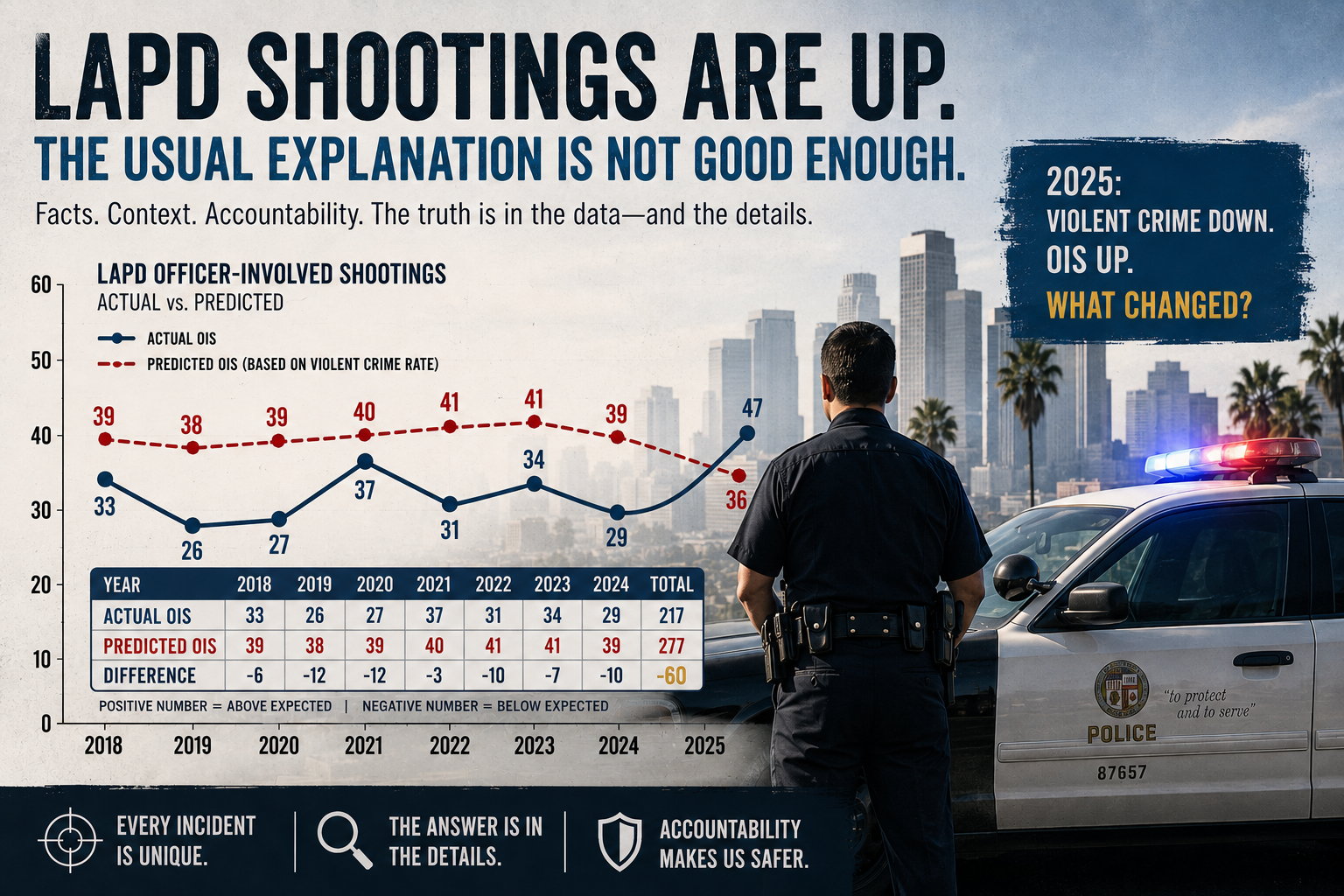
The recent increase in LAPD officer-involved shootings deserves serious public scrutiny. When police shootings rise, the public deserves more than reassurance from the department or slogans from critics. It deserves facts, context and a careful review of what actually happened.
That context matters.
There were 115 officer-involved shootings in Los Angeles in 1990, during one of the highest-crime periods in the city’s history. Yet for more than two decades, annual LAPD OIS totals remained below 50. That reduction did not happen by accident, nor can it be explained solely by lower crime. Even during years when violent crime remained high, LAPD reduced shootings substantially.
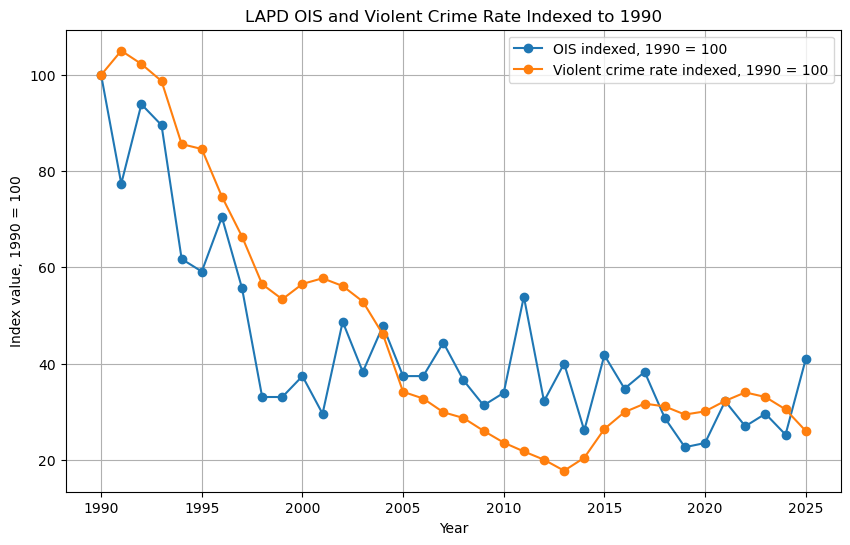
30+ years of OIS and violent crime
To the department’s credit, much of that reduction can be attributed to training, policy changes, improved supervision, tactical review, less-lethal options and a sustained commitment to holding officers accountable for every round they fire. LAPD has lived under intense scrutiny for decades. While that scrutiny has often been uncomfortable, it helped produce a culture in which deadly force is reviewed, questioned and improved.
I have tracked LAPD officer-involved shooting data for many years, including during my 33-year service there. A regression analysis comparing annual LAPD OIS totals with the city’s violent crime rate from 1990 through 2025 shows a strong relationship. Violent crime does not explain everything, but it explains a great deal. In the model, the violent crime rate accounts for approximately 71% of the variation in annual LAPD shootings. For every 100-point increase in the violent crime rate per 100,000 residents, the model predicts roughly three additional OIS incidents.
That matters because LAPD shootings have not moved randomly over time. They have generally risen and fallen with the city’s violent crime environment.
But the recent data show something often overlooked: LAPD was outperforming the model for several years before 2025.
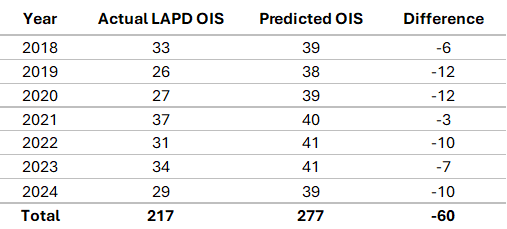
Actual OIS vs Predicted, based on regression analysis
Taken together, from 2018 through 2024, LAPD recorded 217 officer-involved shootings compared with 277 predicted by the violent-crime model — about 60 fewer shootings than expected.
That is not a small achievement. It suggests LAPD’s training, supervision, review process, tactics and less-lethal force options were having a measurable effect. Indeed, the trend happens to correspond with the Department’s 2018 Management-and-Control policy. The department deserves credit for that.
Then came 2025.
In 2025, the violent crime rate declined to 625 per 100,000, one of the lowest rates in the series. Based on that rate, the model predicted approximately 36 LAPD officer-involved shootings. LAPD recorded 47. That is 11 above expected and a clear break from the prior seven-year pattern.
That is the real question: what changed?
The answer will not be found in broad violent crime totals alone. Nor will it be found in slogans, assumptions or agency-to-agency comparisons stripped of context. The only way to understand the 2025 increase is through a full review of each officer-involved shooting.
Every police use-of-force incident is unique. Each must be evaluated on its own facts: what the officers knew at the time, what the suspect did, whether the suspect was armed, and whether the incident involved a firearm, replica gun, edged weapon, vehicle, mental-health crisis, suicidal behavior, foot pursuit, assault on officers or rapidly evolving threat.
Aggregate data can tell us that 2025 was unusual. It can show LAPD had more shootings than expected based on the violent crime rate. But aggregate data cannot tell us whether a specific shooting was justified, preventable, tactically sound or avoidable. That requires disciplined incident-by-incident review.
What should be avoided is the lazy explanation that a sudden spike in police shootings must be the product of racial bias. Bias should never be ignored where evidence supports it. But as an explanation for a sudden one-year increase in a majority-minority police department, it is thin unless someone can identify what changed during the same period. Slogans and ideology are not analysis.
A more plausible hypothesis is that the post-2020 policing environment has changed the character of police encounters.
Much has been said about the “Ferguson effect” or de-policing: the possibility that relentless criticism, political second-guessing and fear of career-ending scrutiny cause officers to pull back from proactive enforcement. That is one side of the problem. The other side should also be acknowledged.
Persistent anti-police rhetoric and demonization may embolden the most committed offenders. Not the average resident. Not the person who calls 911 and cooperates. But the lifelong offender, the armed suspect, the person already inclined to flee, resist, carry a gun or challenge lawful authority.
If that person believes officers are hesitant, unsupported or politically isolated, street encounters can become more dangerous. Officers may intervene too late, when situations are already unstable. Suspects may be more willing to resist. The result can be fewer overall enforcement contacts but more encounters that reach the point of deadly force.
That hypothesis should be tested, not dismissed.
This is not an argument against police accountability. LAPD’s own history shows that accountability, training and review can reduce shootings. But accountability is not the same as reflexive condemnation.
The public deserves more than a raw count and more than a political narrative. LAPD shootings increased in 2025 despite a decline in violent crime. That fact should concern everyone. But the explanation is unlikely to be found in a single accusation. It will be found in the facts of the encounters themselves.