

Good outcomes are built long before the moment of truth
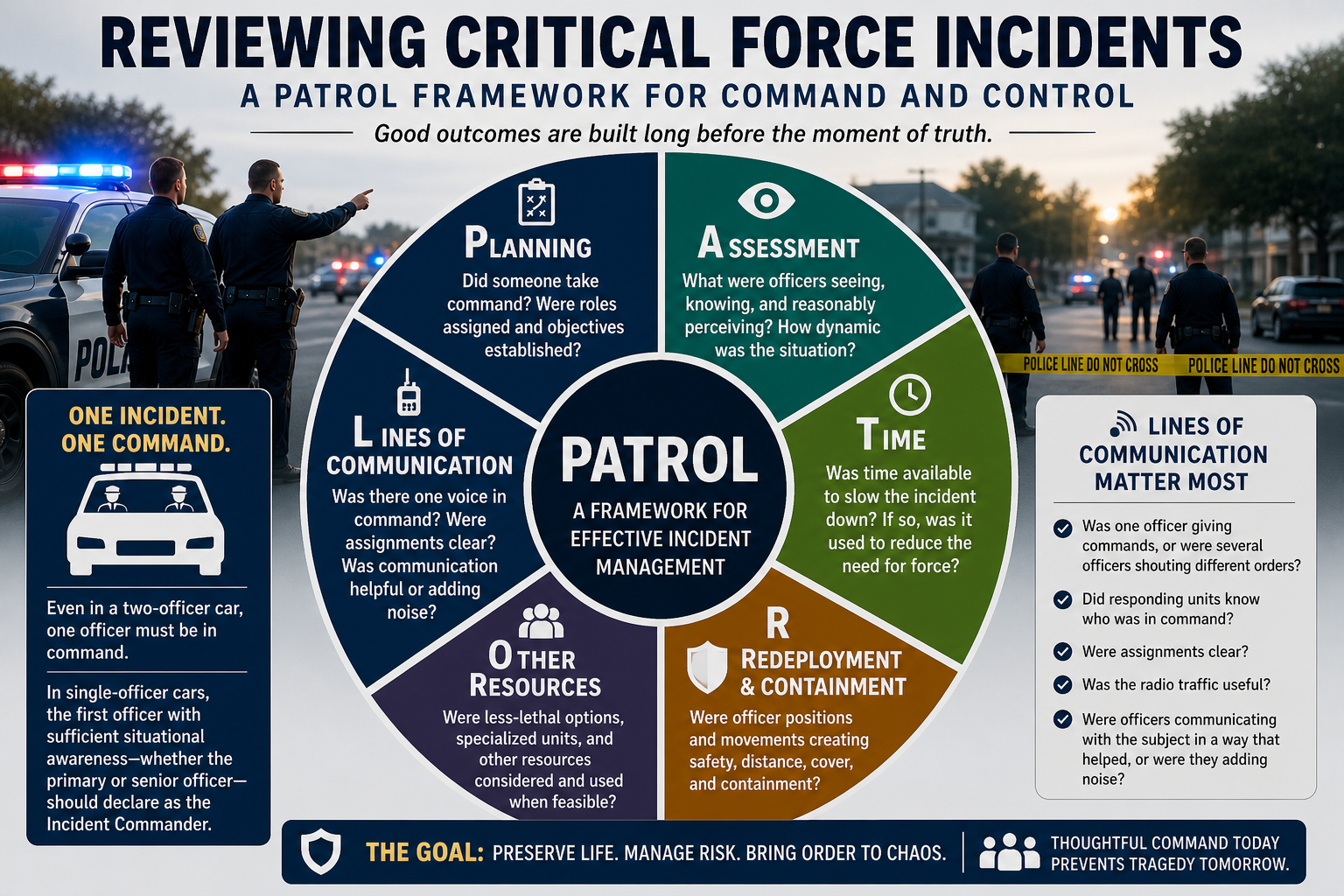
Design based on LAPD training bulletin concepts
Reviewing Critical-force Incidents
Across the country, the review of police deadly force is moving beyond the old question of whether an officer faced danger at the precise instant force was used. California has already codified that movement. Penal Code section 835a now states that deadly force should be used only when necessary, in defense of human life, and officers are expected to consider available resources and techniques when reasonably safe and feasible.
The courts are moving in the same direction. In Barnes v. Felix, the United States Supreme Court rejected the narrow “moment of threat” rule, holding that Fourth Amendment force reviews must consider the totality of the circumstances, including relevant events leading up to the use of force. California reached a similar destination under state negligence law in Hayes v. County of San Diego, where the California Supreme Court held that liability may arise from tactical conduct and decisions preceding deadly force if, under the totality of the circumstances, those decisions made the use of force unreasonable.
That does not mean every bad outcome is proof of bad tactics. It does mean reviewers should resist the old habit of looking only at the final seconds.
The Los Angeles Police Department’s Command and Control training bulletin offers a practical way to conduct that broader review. The bulletin defines Command and Control as active leadership used to direct personnel, coordinate resources, accomplish tasks, and minimize risk. It also identifies PATROL as a tool for establishing Command and Control: Planning, Assessment, Time, Redeployment and/or Containment, Other Resources, and Lines of Communication.
Planning asks a basic question: did anyone take charge? In a critical incident, planning may be imperfect and compressed. Nobody should expect a field officer to produce a conference-room strategy while a person is armed, unstable, or violent. But there still needs to be direction. Who identified the problem? Who assigned roles? Who decided whether officers should hold, move, contain, communicate, evacuate, or deploy less-lethal options? A scene full of officers is not the same thing as a managed response.
Assessment requires reviewers to look at what officers knew, what they reasonably perceived, and what they should have been processing as the incident unfolded. Was the subject armed? Was the weapon being used against others, displayed, concealed, or merely reported? Were there victims nearby? Was the person suicidal, assaultive, fleeing, barricaded, or confused? Were officers dealing with a static problem or a rapidly deteriorating one? Good assessment is not hindsight. It is disciplined attention to the facts available at the time.
Time may be the most misunderstood factor. Time is valuable when it exists. It allows officers to slow the pace, create distance, bring in supervision, establish communication, deploy less-lethal tools, and reduce confusion. But time is not always available. A suspect actively stabbing someone, pointing a firearm, or closing distance with a deadly weapon can collapse decision-making into seconds. The fair question is not, “Could officers have waited?” The better question is, “Was time reasonably available, and if so, did officers use it to reduce the need for force?”
Redeployment and containment focus on officer positioning. Did officers move to cover? Did they create distance? Did they avoid crowding the subject? Did they contain movement and protect the public? Poor positioning can manufacture urgency. Better positioning can lower the temperature. It can also reduce the number of officers who believe they must use deadly force at the same time.
Other resources asks whether officers considered the tools and personnel available to them. That may include less-lethal options, shields, K-9, air support, crisis negotiators, mental health teams, additional supervisors, medical personnel, or specialized units. But resources are not magic either. They must be feasible, timely, and relevant. Calling for a resource that cannot arrive in time may look good in a report, but it may not change the reality on the ground. By contrast, when a resource is reasonably foreseeable, available, and important to a planned event, failing to secure it may be a legitimate basis for critique.
Lines of communication are often where incidents succeed or fail. Command does not begin when a supervisor arrives; it begins when someone on scene takes responsibility for organizing the response. Even in a two-officer patrol car, one officer needs to function as the lead voice. In single-officer deployments, the first officer with sufficient situational awareness — whether the primary officer or the senior officer present — should clearly establish who is managing the incident until relieved. Was one officer giving commands, or were several officers shouting different orders? Did responding units know who was in command? Were assignments clear? Was the radio traffic useful? Were officers communicating with the subject in a way that helped, or were they adding noise?
PATROL does not turn force review into a search for perfection. Police officers still face dangerous, unstable, and fast-moving events. Some uses of deadly force are necessary despite sound tactics.
But PATROL does force the right questions. Was there leadership? Was there assessment? Was time used when available? Were officers positioned wisely? Were resources considered? Were communications clear?
That is the proper direction of modern police force review. Good outcomes are built long before the moment of truth.