Policing Is Thinking
Part I: How closing car doors can prevent pursuits, shootings, and avoidable uses of force
Ken Aston, the legendary soccer referee, once said, “Refereeing is thinking.”
He meant that good refereeing is not merely reacting after the foul. The best referees read the game. They study body language. They sense frustration building. They recognize trouble before it happens and take small steps early to keep the match from becoming unmanageable.
The same is true in policing: Policing is thinking.
Good police work is not simply reacting to danger after it appears. It is evaluating what is happening, sizing up what may happen next, recognizing complications before they develop, and taking reasonable steps to keep a manageable situation from becoming a crisis.
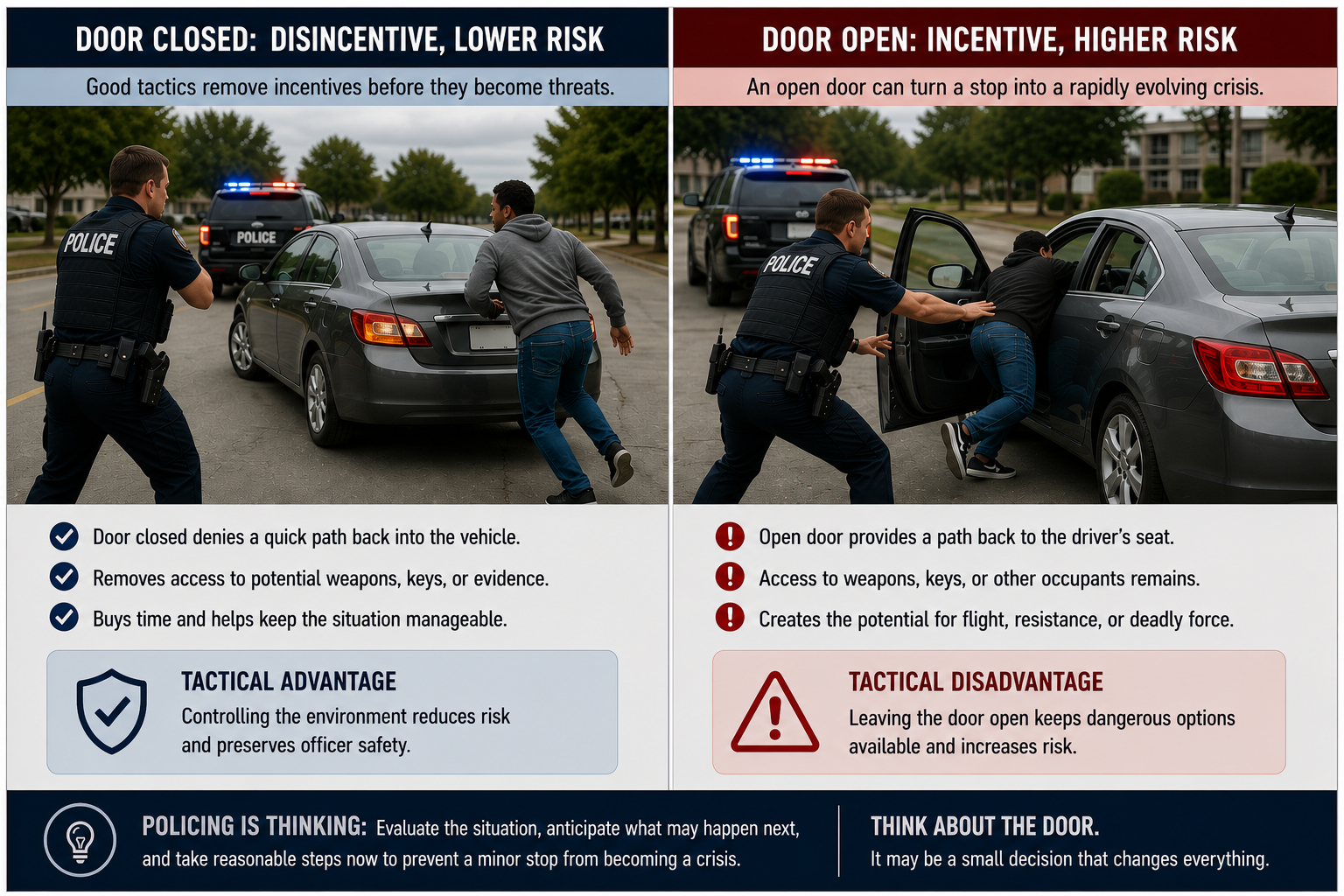
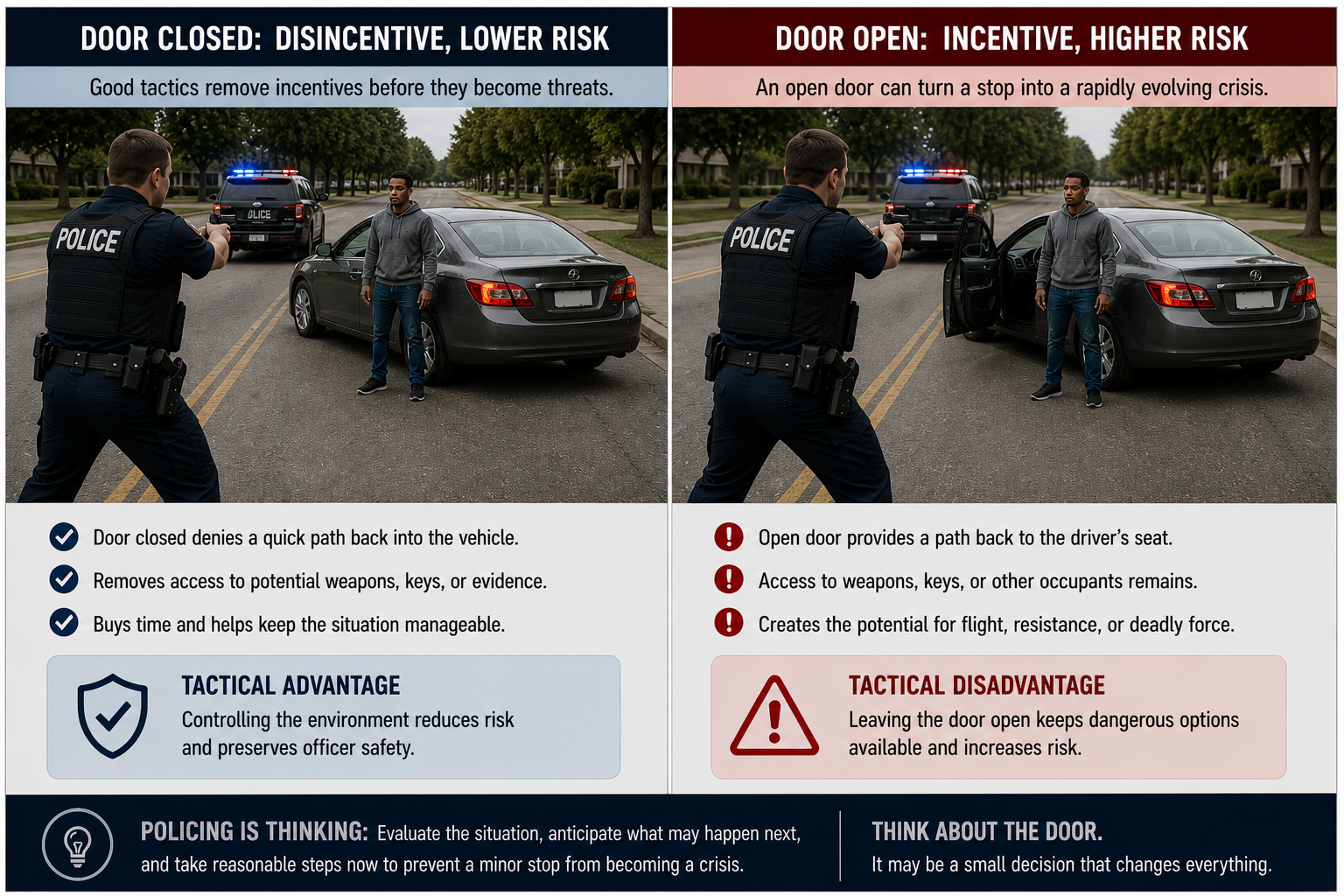
One simple traffic-stop tactic deserves serious discussion: when a driver or passenger is removed from a vehicle, officers should consider getting the door closed behind that person, as long as it is safe and lawful to do so.
The open-door problem
Officers are trained to watch hands, maintain distance, use contact-and-cover, avoid crossfire, and control positioning. Those principles matter. But the vehicle itself can become the central problem.
A vehicle is not just transportation. During a traffic stop, it may also be a source of weapons, a means of escape, a place to conceal evidence, a barrier, or a weapon.
Two police shootings will illustrate my point, but they are only two of dozens across the country.
Daunte Wright: a minor stop that became a deadly-force incident
The death of Wright in Brooklyn Center, Minnesota, illustrates the issue.
Daunte Wright was stopped for traffic and equipment violations in Brooklyn Center, MN, in 2021. During the stop, officers learned he had an outstanding warrant and attempted to arrest him. Wright resisted, broke away, and got back into the driver’s seat through the left open door. The senior officer said she intended to use her Taser but fired her handgun instead, killing Wright. She was later convicted of manslaughter.
No one can honestly say closing the door would have prevented the shooting. But the case shows how quickly a relatively minor traffic stop can collapse once a noncompliant driver has a path back into the vehicle.
Once Wright got back into the driver’s seat, the situation shifted from arrest-and-control to possible vehicle flight, a moving car, and a rapidly collapsing tactical situation.
A closed door could have changed the timing and trajectory of the encounter. It might have made reentry harder. It might have bought time. It might have defeated Wright’s impulse or incentive to resist.
Policing is thinking means recognizing that the open door is not neutral. Open, it gives the driver an option. Sometimes that option becomes the whole case.
Russell Douthit: when the vehicle remains a threat
A 2022 LAPD Harbor Division shooting presents a different but related problem.
Two LAPD Harbor Division officers detained a car in San Pedro containing four occupants outside a liquor store. Russell Douthit was seated in the left rear passenger seat. After establishing reasonable suspicion, officers removed occupants one at a time. When an officer ordered out Douthit, he left objects on the seat. During a pat-down, the officer recovered a loaded handgun from Douthit’s waistband.
At that point, the tactical situation changed. Having found one gun, with another passenger still in the car, the officer stopped searching, backed away, and requested backup.
The officers ordered Douthit to his knees near the open rear door. He was not handcuffed. Officers gave him commands to move away from the passenger compartment. Instead, Douthit lunged into the back seat with both hands and came back out holding a dark object. An officer fired one round, striking Douthit in the hand. The object turned out to be a cell phone. The District Attorney later found the shooting justified. No argument there.
The point is tactical
Once a handgun had been recovered from Douthit’s waistband, the officers were in a high-risk situation, waiting for backup. Because the door issue had not been closed when Douthit was removed, it was now too late to address it safely. Douthit was not handcuffed, within arm’s reach of the open car, and only he knew what was in the back seat. One gun has already been removed from his waistband.
A closed door could have changed the encounter. At minimum, it would have slowed or limited Douthit’s ability to reenter the vehicle.
The facts in the two cases are different, but the lesson is the same: the vehicle is not neutral if the suspect can still get into it.
Best practice: close the door
When a driver or occupant is lawfully directed out of a vehicle, officers should consider instructing that person to close the door behind him, assuming it can be done safely.
Good tactics often work by removing options before they become threats.
Not every door in every case must be closed. Tactics are situational. Sometimes an officer may want the door open to see inside the vehicle. Sometimes he may need to preserve evidence, monitor another occupant, or avoid putting the suspect’s hands near the door. Sometimes closing the door creates a worse problem than leaving it open.
So, the point is not: always close every door.
The point is: think about the door.
What does the open door give this person? Can he get back into the driver’s seat? Are the keys in the vehicle? Can he reach a weapon? Can he reach property, clothing, or a phone that may complicate the encounter? Can another occupant slide into the driver’s seat? Will the open door incentivize flight or resistance?
These questions are the essence of policing as thinking.
Objective reasonableness is not just the moment of force
Too many use-of-force discussions focus entirely on the final second: the lunge, the reach, the movement, the shot. The final second matters. But it is not the whole case.
In Barnes v. Felix, the Supreme Court rejected the narrow “moment of threat” approach and reaffirmed that excessive-force analysis must consider the totality of the circumstances, not merely the instant force was used.
That does not mean every tactical imperfection makes a later use of force unreasonable. Police work is not performed in a classroom. Officers deal with uncertainty, poor lighting, incomplete information, stress, resistance, traffic, bystanders, and rapidly changing behavior.
But earlier decisions matter.
Where was the suspect placed? Was he left near an open vehicle door? Was he handcuffed? Was he moved away from the passenger compartment? Was the vehicle still accessible? Had officers already discovered a weapon? Was the suspect given an easy route back to the source of danger?
This is not officer gotcha. They are the questions serious trainers, supervisors, investigators, and attorneys should ask.
Not Monday-morning quarterbacking
Some will say it’s obvious watching a video, but in my 33 years in law enforcement I never heard this point made, let alone stressed or included in a curriculum.
Fair enough. Video review is not the same as standing on asphalt at night, dealing with a resistant suspect, multiple occupants, poor lighting, and incomplete information. But training exists because officers do not get perfect conditions.
The point is not to criticize every officer who leaves a door open. The point is to identify a repeated pattern and ask whether a small tactical habit could reduce risk.
The issue is easy to overlook, and it is easy to fix.
Policy and training
Agencies should consider adding door-control concepts to traffic-stop training, pursuit-prevention training, and use-of-force review. It may be as simple as making officers more aware and asking the right questions.
“Did you leave the door open for a reason?”
Sometimes the answer will be yes. Sometimes it will be no. Either answer is useful because it forces the officer to think tactically and sets the expectation they will be asked.
A reasonable training principle might say:
When a driver or occupant is removed from a lawfully stopped vehicle, officers should consider whether the open vehicle door creates a risk of reentry, flight, weapon access, or destruction of evidence. When safe and lawful, officers should consider directing the occupant to close the door, moving the occupant away from the vehicle, or otherwise controlling access to the passenger compartment. These actions should be based on officer safety, scene control, and deescalation.
That language preserves officer judgment. It does not pretend every stop is the same. It simply reminds officers to treat the vehicle as part of the tactical environment.
It’s not overthinking, it’s smart policing. Policing is thinking.
In Part II, I will address a related but legally more sensitive issue: whether officers should ask drivers to turn off the vehicle and voluntarily hand over the keys or key fob during certain traffic stops. The tactical value is obvious, but the legal and policy questions deserve separate treatment.