

Sacramento Deserves Better Than Advocacy Math on Police Stops
The ACLU’s recent report on Sacramento police traffic stops presents itself as data analysis, but its conclusion is advocacy dressed in statistical clothing. The report claims Sacramento police use minor traffic violations as racial pretexts to stop and search Black and Latino drivers, and it urges the city to prohibit many of those stops. That is a serious charge. It deserves serious analysis.
This report does not provide one.
The ACLU points to real disparities. Black drivers are stopped and searched at higher rates than White drivers. Black drivers are also more represented in equipment and non-moving violation stops. Those facts deserve scrutiny. But disparity is not, by itself, proof of racial profiling. It is the beginning of the analysis, not the end.
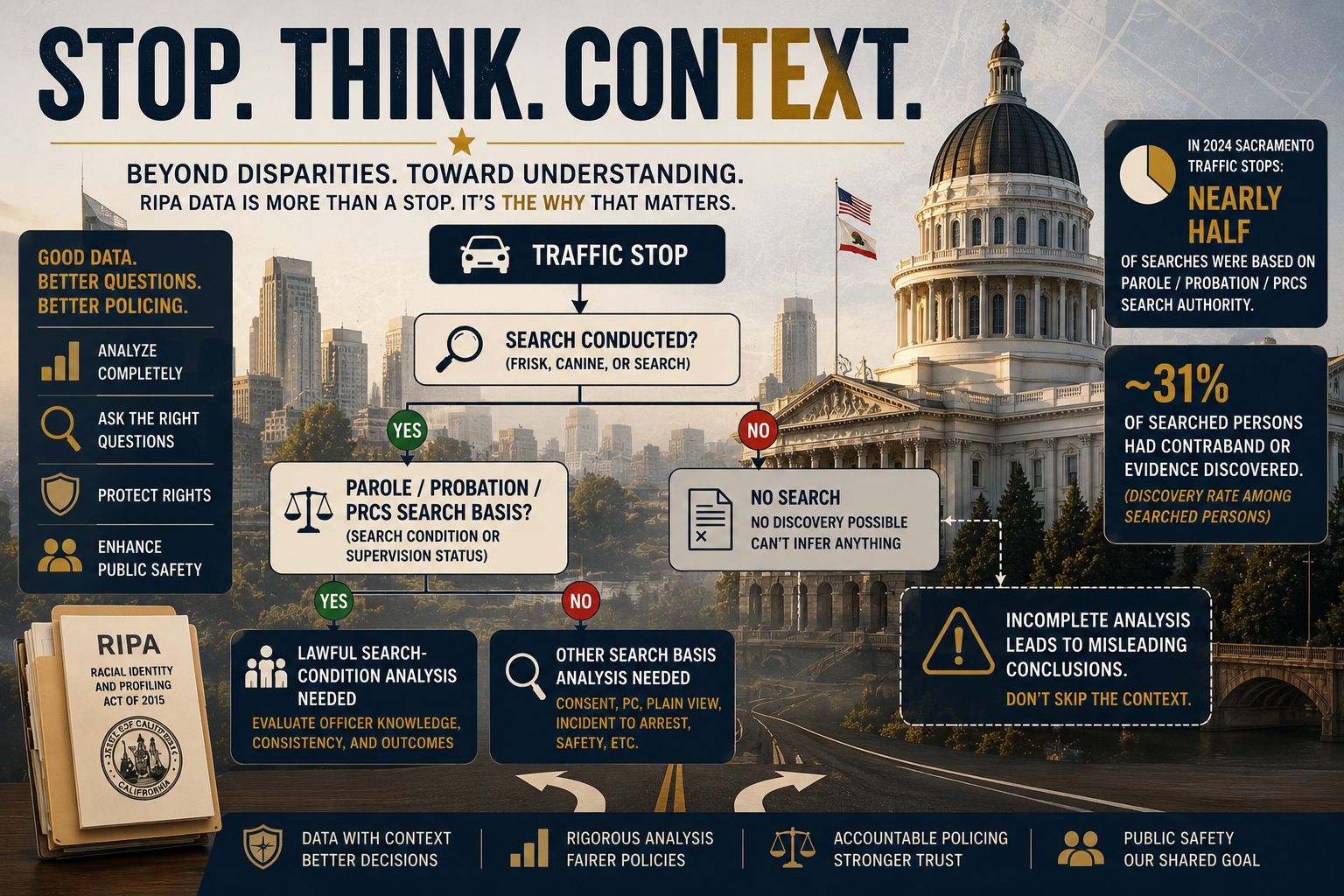
The report’s biggest failure is that it does not adequately explain why searches occurred. RIPA data does not merely tell us whether a person was searched. It also records the reported basis for the search, including parole, probation, PRCS, or mandatory-supervision search conditions. That matters enormously.
In Sacramento’s 2024 traffic-stop data, nearly half of all search, frisk, or canine-search records listed parole/probation/PRCS/mandatory supervision as a basis for the search. That single factor explains a large part of the elevated search rate for Black stopped persons. It does not prove every search was proper. It does not answer whether officers asked about supervision status evenly across racial groups. But it absolutely changes the question.
The question is not simply, “Why are Black drivers searched more?” The better question is, “How many searched persons were subject to lawful search conditions, and how did officers come to know that?” The ACLU largely skips that question.
The report also mishandles discovery rates. It emphasizes that 90% of searches resulted in “no items seized,” then uses that number to suggest traffic-stop searches rarely find contraband. But “no items seized” is not the same as “nothing was discovered.” RIPA separately records contraband or evidence discovered and property seized. Firearms, ammunition, weapons, drugs, alcohol, money, drug paraphernalia, stolen property, electronic devices, and other evidence are discovery categories; seizure is a separate issue. The ACLU’s own report relies heavily on “no items seized” to argue searches have little value.
That is misleading.
A discovery rate should be calculated only among stops where officers actually searched, frisked, or used a canine. You cannot count a non-search as a failure to discover contraband. No one looked. No search occurred. In the 2024 Sacramento traffic-stop data I reviewed, 2,575 records involved a search, frisk, or canine search. Contraband or evidence was recorded in 808 of those records — about 31%. That is not “almost never.” It is roughly one discovery for every three searched persons.
That number matters because the policy debate is not cost-free. The popular movement to reduce police stops or prohibit pretext stops treats traffic enforcement as if it has only one effect: inconvenience or harm to motorists. That is not reality. Traffic stops also deter crime. They raise the perceived risk for people driving around with guns, drugs, stolen property, warrants, or parole and probation search conditions.
I saw this dynamic firsthand.
From 2019 to 2021, I served as chief crime analyst for the Los Angeles Police Department. During that period, following the George Floyd demonstrations and rioting, violent crime, shootings, and homicides rose dramatically. At the same time, political decisions reduced police presence and proactive activity in parts of Los Angeles where violent crime was already concentrated, especially South Los Angeles. Police stops dropped sharply — by roughly half — in the months and years that followed.
Some argued the rise in shootings was caused by more guns being stolen from homes. I researched that theory at the time. I did not find evidence that more guns were being stolen in 2020 than the year before. What I did find was more troubling: gun seizures from car stops increased more than 30% even as total car stops dropped. In plain English, fewer cars were being stopped, but more guns were being found in the cars that were stopped.
That suggests something important: more people were driving around armed.
I also found that much of the increase in shooting victims was not simply because there were vastly more shooting incidents. A major share of the increase was driven by shootings with multiple victims. That reflected a behavioral shift. The traditional “spray-and-pray” drive-by shooting, where hitting the intended target was often uncertain, became less common. More shootings became walk-ups. A shooter who walks up on a target has a better chance of hitting him, a better chance of killing him, and a greater incentive to shoot others nearby who might be witnesses or might return fire.
Why would that change happen? In my judgment, offenders understood the environment had changed. Fewer police. Fewer stops. Less visible enforcement. Lower perceived risk.
That is deterrence in reverse.
When policymakers reduce police stops, they may reduce unpleasant encounters for law-abiding drivers. That benefit is real. But they may also reduce the perceived risk for armed offenders moving through the city. That cost is also real. The ACLU report barely acknowledges it.
None of this means Sacramento police should have unlimited discretion. They should not. If officers are using minor violations as dishonest excuses to investigate people based on race, that should be exposed and stopped. But proving that requires more than comparing stop counts to residential demographics and declaring racism. City population is a weak benchmark for traffic stops. Drivers on Sacramento streets include commuters, visitors, delivery drivers, rideshare drivers, people passing through commercial corridors, and people under criminal justice supervision.
A serious audit would separate traffic stops by violation type, location, time of day, call-for-service status, passenger status, search basis, supervision status, discovery, seizure, and outcome. It would distinguish consent searches from parole/probation searches, officer-safety frisks, inventory searches, searches incident to arrest, and searches based on visible contraband. It would ask whether officers are asking about parole or probation status at different rates by race. It would not pretend “no seizure” means “no discovery.”
The ACLU report identifies disparities. That is useful. But then it leaps from disparity to motive, from motive to civil-rights violation, and from civil-rights violation to a sweeping policy demand.
Cities like Sacramento and Los Angeles deserves better than that.
The real question is not whether racial profiling should be tolerated. It should not. The real question is whether California police agencies can reduce improper stops without dismantling one of the few tools officers have to find guns, locate wanted persons, enforce lawful search conditions, and deter armed offenders before the next shooting.
That is the public-safety tradeoff. The ACLU’s report avoids it. The city councils should not.