

An Indictment Is Not a Use-of-Force Analysis - People v. Matthew Neely
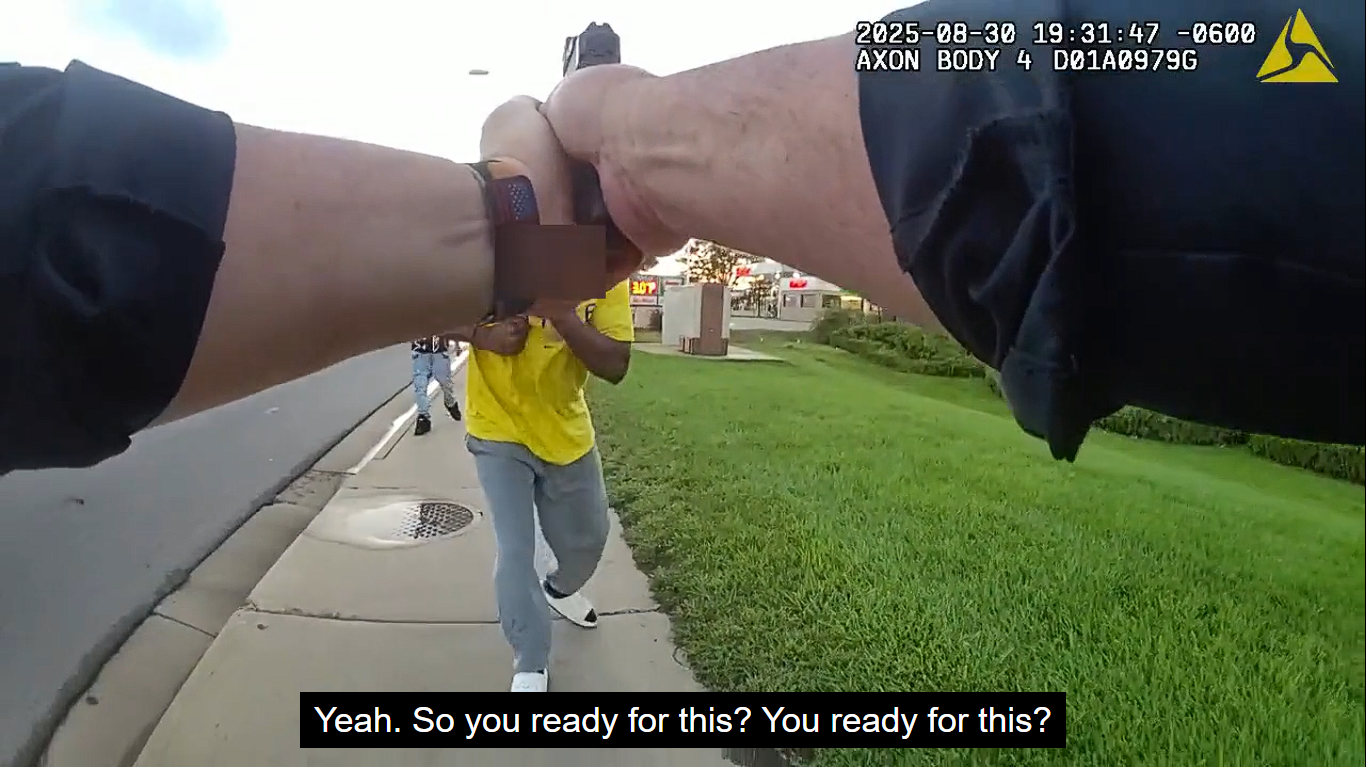
Now indicted Aurora PD officer Matthew Neely attempting to hold combative suspect at bay until back up arrives.
A grand jury’s indictment of Aurora Police Officer Matthew Neely for second-degree murder and manslaughter is serious. It is not a verdict. Several facts in the indictment may cut against the conclusion prosecutors want the public to draw.
The confrontation began after Rajon Belt-Stubblefield allegedly accelerated away from Neely and crashed into two vehicles. He disobeyed commands to remain in the Jeep, emerged with a handgun and threw it into nearby grass. He then repeatedly directed companions to “go get that shit.” Neely was alone, had already been knocked to the ground during a struggle and faced a larger, younger man while others moved near a recoverable firearm. Those facts also appeared in Police Chief Todd Chamberlain’s early account—an account that drew accusations that he had prejudged the shooting.
These details define the environment in which reasonableness must be judged.
The indictment emphasizes what Neely did not do: continually update dispatch, announce an arrest, successfully holster his pistol, deploy pepper spray, or repeat his earlier warning -- “I’ll shoot you” --immediately before firing. Some are legitimate tactical questions. But tactical imperfection is not automatically criminal recklessness, much less murder.
Colorado law asks whether an officer reasonably believed lesser force was inadequate and he faced imminent death or serious bodily injury. It generally requires a warning unless one would increase the danger. A jury should consider Neely’s earlier warning and whether another was feasible, not demand magic words in the final second.
The indictment says Belt-Stubblefield raised both fists, adopted a boxer’s stance, challenged Neely with words to the effect of “Are you ready for this?” and advanced while Neely backed into traffic. It admits Belt-Stubblefield chose to exit the car with gun in hand rather than leave, then throw the gun and invoke compatriots to retrieve it. His empty hands are relevant, but not conclusive, when an armed officer says he feared being overpowered and disarmed. That does not automatically justify shooting. It does make the state’s repeated emphasis that Belt-Stubblefield’s hands “appeared to be empty” an incomplete description of the threat Neely says he perceived.
The third shot—to the head after two rounds to the chest—will draw the closest scrutiny. Neely reportedly said the first two rounds did not stop the threat, so he changed his target. Police train in a “failure drill” for a threat that continues after center-mass hits. That is context, not a legal safe harbor; every shot must be justified. Yet body-camera video shows a sequence lasting well under a second. Belt-Stubblefield appears upright through the recoil and begins collapsing immediately afterward. The video does not show a distinctly later execution-style shot at a man already down or visibly neutralized.
More troubling is the indictment’s repeated reliance on what “Defendant stated.” If those quotations came from a compelled administrative interview, their use would raise a serious Garrity issue. Under Garrity v. New Jersey, a compelled statement—and evidence derived from it—may not be used against an officer in a criminal case.
The public document does not reveal enough to declare the grand jury tainted. But it quotes Neely’s explanations about preserving surprise, changing targets, and fearing disarmament. The district attorney should identify the source of those statements and, if they were compelled, explain how the grand-jury presentation was insulated from them. A “clean-team” investigator cannot cure the problem merely by repeating protected answers through another witness.
That uncertainty feeds a larger concern. Why does the indictment catalogue tactical criticisms while giving comparatively little weight to facts that may establish reasonable fear? Why quote Neely’s explanations if the public cannot determine whether the statements were lawfully available to prosecutors? Those choices do not prove an ideological prosecution, but they justify skepticism about whether the district attorney is neutrally testing criminal culpability or trying to make an example of this officer.
That distinction matters because the process can become the punishment. Even an acquitted officer may face crushing legal expenses, years of uncertainty, public condemnation, and the practical end of a law-enforcement career. A union or insurer may cover some costs, and reinstatement may be legally possible. None of that restores lost years or reputation or the longevity lost to stress. A prosecutor need not win a case to impose life-altering consequences.
Neely is entitled neither to automatic exoneration because he wore a badge nor to a presumption of guilt because a grand jury found probable cause. Prosecutors should charge an officer when the evidence supports a good-faith belief that a crime can be proved beyond a reasonable doubt. But if this case is being used to announce a political position, punish an unpopular use of force or satisfy an ideological constituency, then the criminal process is being misused. The public deserves assurance that the charge rests on evidence of an unjustified shooting—not hindsight, a tactical checklist, or a desire to place an officer on trial simply because placing him on trial is itself the desired result.