

Punish Those Who Misuse Guns, Not Those Who Own Them Responsibly
Suzanne York's recent op-ed calling for stricter gun laws begins with something on which nearly everyone can agree: children should not be murdered in schools, dangerous people should not have firearms, and adults who recklessly place guns into the hands of dangerous children should be held accountable.
Where we disagree is over the solution.
York advocates nationwide background checks, waiting periods, red-flag laws, ammunition restrictions, and bans on assault-style weapons and ghost guns. Underlying her argument is the familiar assumption that America's principal problem is access to firearms.
I would suggest we're concentrating too much on the instrument and too little on the person using it.
Consider the numbers.
According to the CDC, 44,447 Americans died from firearm injuries in 2024. Of those, 27,593—more than 62 percent—were suicides. Another 15,364 were homicides.
Every death matters. But suicide and criminal homicide are fundamentally different problems, involving different motivations, circumstances and potential remedies. Combining them under the emotionally powerful label "gun violence" can obscure those distinctions.
Firearms are exceptionally lethal in suicide attempts. Research indicates approximately nine out of ten such attempts result in death. Attempts involving other methods, including drug poisoning and cutting, are considerably more survivable. This doesn't diminish the tragedy of suicide. It demonstrates why suicide prevention requires its own approach, addressing mental-health crises, warning signs and access to lethal means.
Criminal violence presents another problem entirely.
The CDC recorded 20,162 homicides in 2024. Firearms accounted for approximately 76 percent. Yet FBI data show firearms were involved in only about 33 percent of aggravated assaults and 32 percent of robberies for which relevant weapon information was reported.
That disparity is revealing. People assault, threaten and rob others using fists, knives, clubs and numerous other weapons. When a firearm enters the confrontation, however, the likelihood of a fatal outcome can increase dramatically.
That is a powerful argument for taking armed criminals seriously. It is not necessarily an argument for restricting everyone who responsibly owns a firearm.
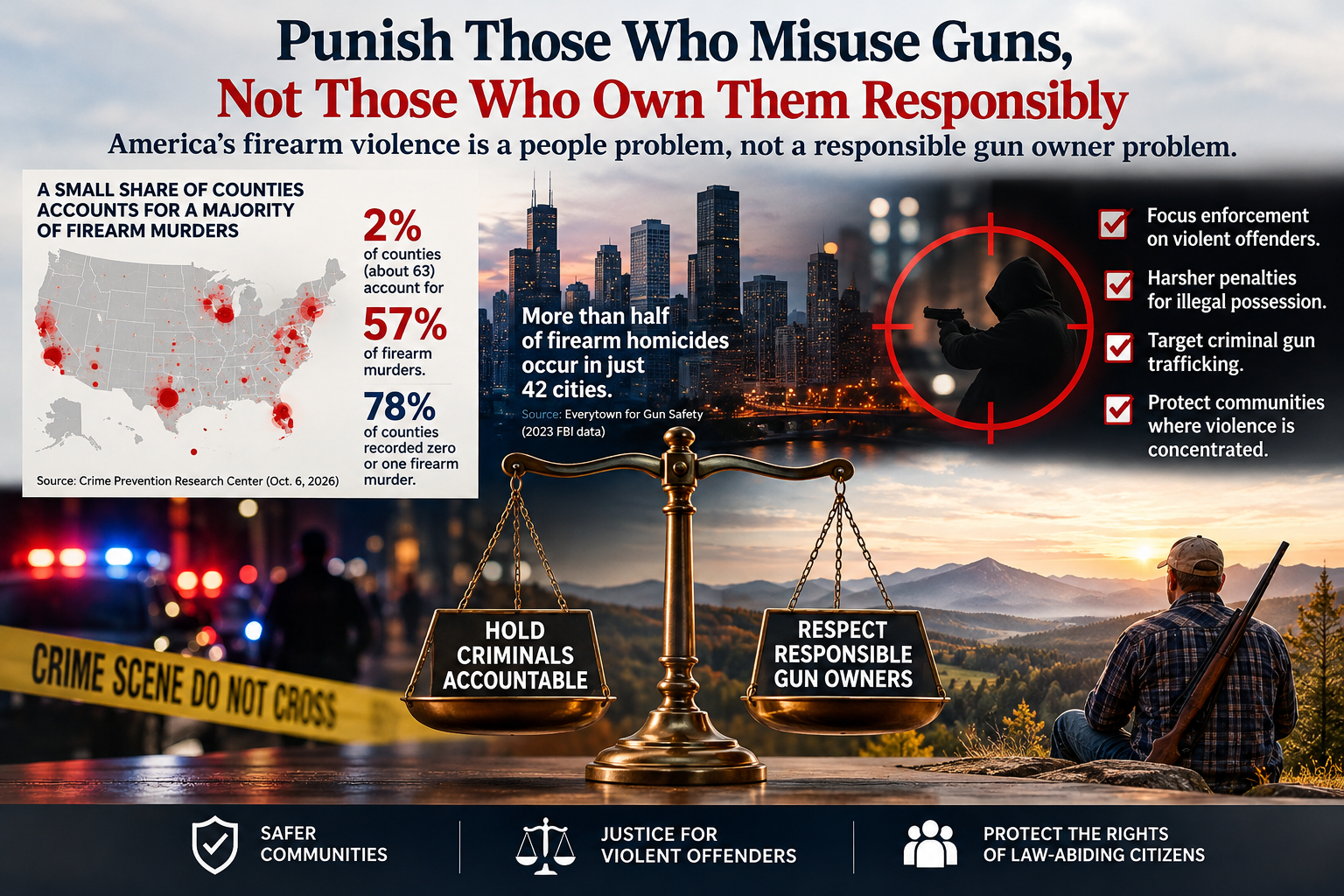
Consider another statistic rarely mentioned in the gun-control debate: the remarkable geographic concentration of firearm homicide.
America has approximately 3,144 counties and county-equivalents. An October 2026 analysis by the Crime Prevention Research Center found that just 2 percent—roughly 63 counties—accounted for 57 percent of firearm murders in its 2025 dataset. Even more striking, 78 percent of counties recorded either zero or one firearm murder.
And this isn't merely a finding from a pro-gun research organization.
Everytown for Gun Safety, one of the nation's leading gun-control advocacy organizations, analyzed 2023 FBI data and found that more than half of the reported firearm homicides in its city dataset occurred in just 42 American cities.
Two organizations on opposite sides of the firearms debate arrive at a similar observation: firearm homicide is heavily concentrated geographically.
Those 63 counties include roughly 30 percent of the nation's population, and the studies use different reporting methods. Nevertheless, the concentration raises an important question.
If firearm murders are so heavily concentrated, why do proposed solutions so often emphasize regulating millions of lawful gun owners nationwide instead of directing greater attention and resources toward the offenders, illegal gun markets and neighborhoods experiencing the violence?
And why do we so rarely hear serious discussion about what happens when a violent offender, already prohibited from possessing firearms, arms himself again?
York compares gun regulation to driver's licenses and speed limits. I like that analogy, although perhaps not for the reason she intended.
When someone repeatedly drives drunk, we take away his license. When a reckless driver kills someone, we prosecute him. When someone deliberately uses an automobile as a weapon, we punish the person responsible, even charging murder after persistent reoffending.
We don't impose collective responsibility on everyone who owns a car.
Why should firearms be different?
Someone convicted of using a gun in a serious violent crime should face substantial punishment and restrictions on future firearm possession, sometimes for years, sometimes for life.
And when that person knowingly arms himself again despite a legal prohibition, the consequences should be meaningful and swift. Repeat violations should ordinarily invite increasingly serious sanctions, with due consideration for the offense, criminal history and circumstances.
There is something inconsistent about declaring firearms extraordinarily dangerous while resisting substantial punishment for people who have already demonstrated dangerous behavior and deliberately possess them illegally.
This is where gun control should be strongest: controlling guns in the hands of people whose conduct demonstrates they cannot be trusted with them.
A Bureau of Justice Statistics survey offers another inconvenient fact. Among prisoners who possessed firearms during the offenses for which they were incarcerated, 90 percent had not obtained those guns from a retail source.
Handguns, incidentally, were far more common among these offenders than rifles.
That doesn't mean background checks are worthless. It means that repeatedly adding restrictions to lawful retail purchases may accomplish less against offenders who acquire guns through criminal or informal channels than advocates acknowledge.
Nor should we ignore the other side of firearm ownership: self-defense.
Nobody knows precisely how many times Americans use firearms defensively each year. Estimates vary considerably. In two recent cases, armed citizens intervened and saved lives. But defensive gun use doesn't always involve shooting someone. Sometimes the visible presence of a firearm is sufficient to discourage a robbery, assault or home invasion.
Such incidents rarely become national news. There is no easily measured category for the woman who wasn't assaulted, the homeowner who wasn't beaten or the robbery abandoned because the intended victim was armed.
And consider the person living in a remote community, on a ranch or in the mountains, where law enforcement may be twenty or thirty minutes away. York assures readers that no homeowner needs an assault-style rifle. But who should decide what a responsible citizen needs to protect his family?
The Constitution doesn't ordinarily require Americans to demonstrate a government-approved need before exercising a protected right.
None of this suggests that every firearm regulation is unreasonable.
Safe-storage requirements that prevent children from accessing guns deserve serious consideration. Adults who recklessly provide firearms to dangerous juveniles should be held accountable. So should illegal gun traffickers, straw purchasers and violent offenders who deliberately violate firearm prohibitions.
On those matters, York and I may agree.
But responsibility must remain an individual concept.
Millions of Americans own firearms throughout their lives without committing a violent crime. They hunt, target shoot, collect firearms and keep them for protection. They shouldn't be treated as though they share culpability with the robber, murderer or repeat violent offender who deliberately misuses one.
York asks whether we have the political will to prevent the next tragedy.
A fair question.
But perhaps we should first ask some others.
Who is committing the violence? Where are the crimes concentrated? How are offenders obtaining their firearms? How many have already demonstrated violent behavior? And when a prohibited person deliberately arms himself again, why aren't we making that conduct a greater enforcement priority with mandatory incarceration?
These questions will not prevent every shooting. Neither will another law imposed on someone who already obeys the law.
If a person demonstrates through his conduct that he cannot be trusted with a firearm, direct the law's force at him.
Punish the armed robber. Punish the violent offender who illegally rearms himself. Punish the trafficker supplying him. Punish the adult who recklessly gives a dangerous child access to a gun.
But don't confuse those people with a citizen who has responsibly owned a firearm for thirty years and harmed no one.
That isn't indifference to gun violence.
It's the difference between regulating an object and holding a human being accountable for what he chooses to do with it.